
The Magic Hour: Finding Your Creative Prime Time (Even When It's Not What You Expected)
Authentic creativity isn't about matching someone else's romantic ideal; it's about showing up consistently for the work in whatever way actually serves your real creative capacity.

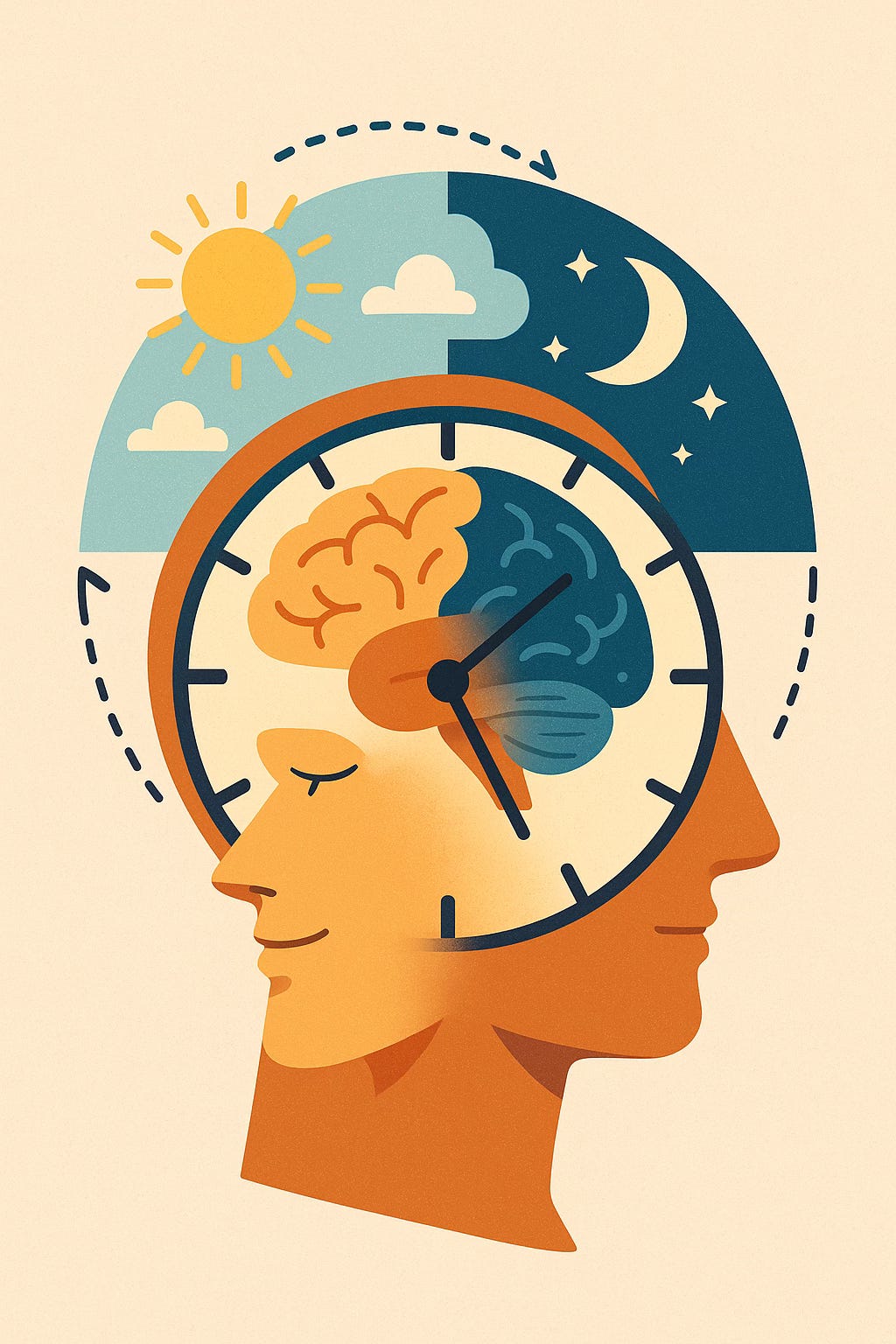
For years, I carried this image in my head of the writer I thought I should be: sitting at a typewriter at midnight, glass of bourbon nearby, cigarette smoke curling toward the ceiling as profound words poured onto the page. It was pure romance, borrowed from every writer biography I'd ever read and every movie about tortured artists creating their masterpieces in the dark hours while the rest of the world slept. And by that guy I briefly dated at 18 who was 23 and emotionally unavailable and was that kind of writer, although it was vodka, not bourbon for him; still, I was mesmerized by what seemed like this grown up writerly self at the time and long after that faded, I still held on to the notion that writers crafting long into the night was how it should be.
The only problem was that this fantasy had absolutely nothing to do with how my brain actually works.
I spent my twenties trying to force myself into this mold, staying up late to write, pushing through exhaustion because I believed that's what "real" writers did. The results were predictably terrible. Late-night writing sessions produced meandering, unfocused work that I'd have to completely rewrite in the morning. I'd wake up groggy and depleted, having sacrificed both good sleep and good writing in service of an image that never fit me.
The truth is, I'm happily in bed by nine most nights, and trying to write past ten o'clock feels like pushing words through molasses. I'm not an early morning person either, despite all the productivity advice that insists successful people wake at 5 AM. My creative sweet spot happens around 9 or 10 in the morning, after I've had time to ease into the day but before the world's demands start pulling my attention in different directions. I’ve never been a smoker and although I do like bourbon, I don’t write well while drinking it.
Learning to honor my actual rhythm instead of fighting it has been one of the most important shifts in my creative practice. It's also taught me something crucial about the difference between the artist we think we should be and the artist we actually are.
You already have the answers to unblocking your creativity. Find them with the help of a Creative Health Map.
The Myth of the Night Owl Creator
There's something deeply appealing about the image of the late-night creative genius. Maybe it's the romance of solitude, the sense that profound work only emerges when the rest of the world is asleep. Maybe it's the association between darkness and depth, night and mystery. Whatever the appeal, this myth has convinced countless artists that their most authentic creative work must happen in the liminal hours between day and night.
But here's what I've learned: your most authentic creative work happens when your brain is actually available for creating, regardless of what time that is.
For some people, that truly is late at night. Their circadian rhythms naturally shift toward evening alertness, and their best thinking happens when the world is quiet and dark. But for many of us, the romance of late-night creating crashes against the reality of our actual neurochemistry.
I spent years judging my preference for earlier creative work as somehow less legitimate, less artistic, less “cool”. Surely the profound insights came during those mysterious midnight hours, not during the ordinary morning light filtering through my kitchen window. This judgment wasn't just about timing, it was about identity. Night writers seemed more serious, more committed, more willing to sacrifice comfort for art. Or something. More something.
Of course, working against your natural rhythms doesn't make you more dedicated, it makes you less effective. All those forced late-night writing sessions weren't producing better work because I was trying harder, they were producing worse work because I was working against my biology.
Finding Your Actual Creative Prime Time
My real creative energy follows a pattern that took me years to recognize and accept. I wake up around 6 or 7, but I'm not immediately ready to dive into demanding creative work. I need time to ease into the day, to have coffee, to let my mind gradually shift from sleep to wakefulness. Trying to write immediately upon waking produces flat, uninspired work because my brain hasn't fully come online yet. I read, I do a crossword, I make a collage.
But somewhere around 9 or 10 in the morning, something shifts. My mind becomes clearer, ideas start connecting in interesting ways, and words begin to flow with less effort. This is my creative prime time, and it typically lasts for about three hours if I protect it carefully.
The key word there is "protect." Once I recognized this pattern, I had to restructure my entire life around it. No morning meetings if I can possibly avoid them. No checking email or social media during those precious hours. No administrative tasks or phone calls that can wait until afternoon. This prime time gets treated like the sacred creative space it is.
I realize this is a luxury that not everyone can afford. The ability to design your schedule around your optimal creative hours requires a level of autonomy that many people don't have. Single parents, people working traditional jobs, caregivers, and others with significant obligations may not be able to protect their creative prime time in the same way.
But even within constraints, there's often more flexibility than we initially realize. Maybe you can't write during your ideal hours every day, but perhaps you can protect one or two mornings a week. Maybe you can't completely avoid morning obligations, but you can minimize them. Maybe you can't control your schedule entirely, but you can be more strategic about when you attempt different types of creative work.
The Permission to Be Who You Actually Are
Learning to work with my natural creative rhythms instead of against them required a fundamental shift in how I thought about creative authenticity. I had to release the romantic fantasies about who I thought I should be as a writer and embrace the reality of who I actually am.
This meant accepting that I'm someone who needs a gentle transition into the day rather than immediate intensity. It meant acknowledging that my best creative work happens during ordinary morning hours rather than dramatic midnight sessions. It meant recognizing that sustainable creative practice requires honoring my actual needs rather than forcing myself into someone else's creative template.
This shift from "should" to "is" has been liberating in ways that extend far beyond creative scheduling. When you stop trying to force yourself into an ill-fitting creative identity, you free up enormous amounts of energy that was previously spent fighting against your nature. That energy can then be redirected toward the actual work of creating.
I've also learned that my morning creative prime time produces different kinds of work than evening writing would. Morning creativity tends to be clearer, more structured, more focused on problem-solving and organization. It's less emotionally raw than late-night writing might be, but it's also more cogent and purposeful. This isn't better or worse than nighttime creativity, it's just different, and it's mine.
Working With Your Creative Clock
Understanding your creative prime time is just the first step. The real work is in designing your life to honor and protect these optimal hours while finding creative strategies for the times when you can't work at peak capacity.
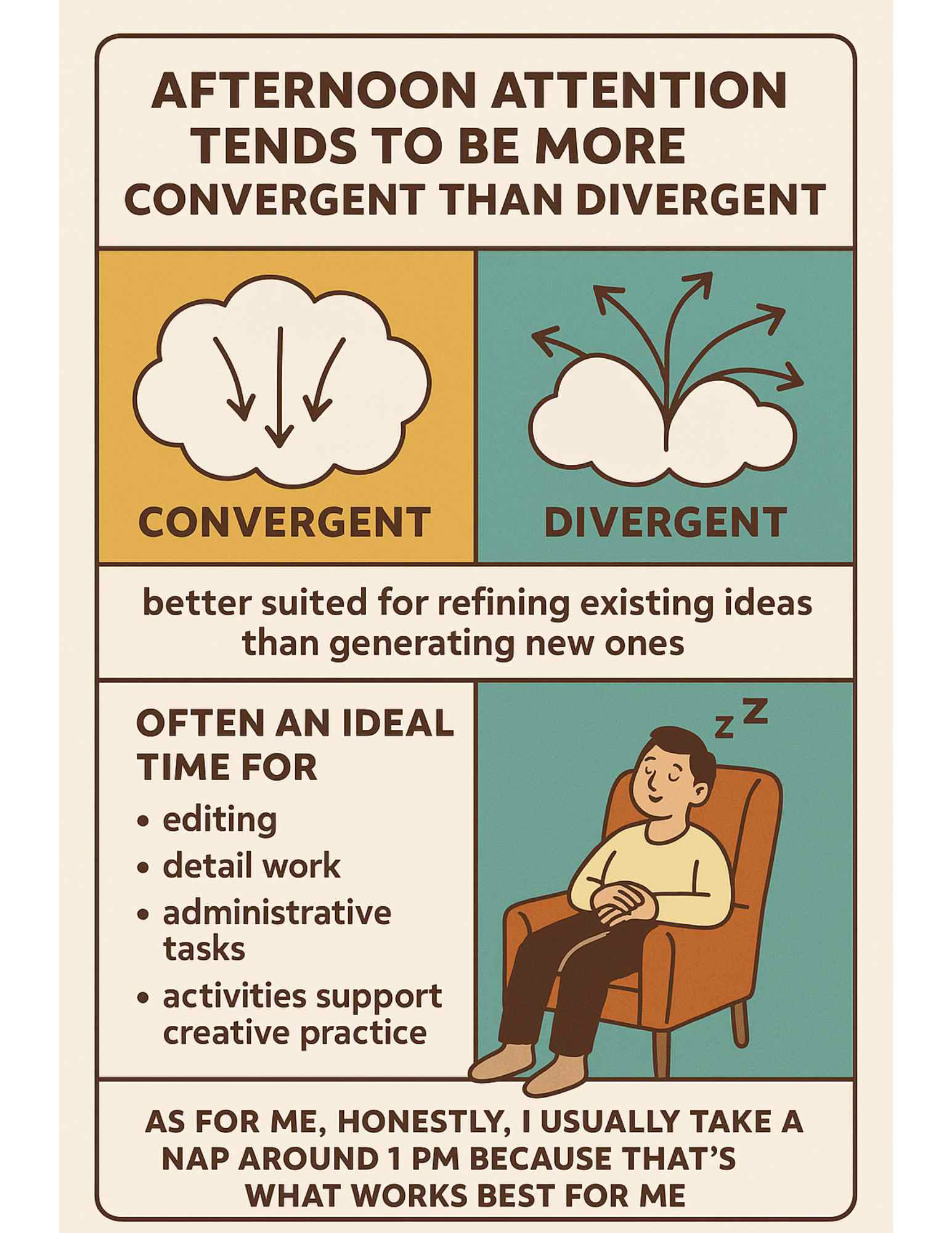
For me, this has meant becoming fiercely protective of morning hours while developing alternative approaches for other times of day. Afternoon energy is better suited for editing, organizing, or research. Evening time works well for reading, planning, or gentle creative activities that don't require peak cognitive performance.
I've also learned to recognize the difference between creative prime time and productive prime time. My most efficient work happens in mid-morning, but I can accomplish different types of creative tasks throughout the day if I match the activity to my current energy state.
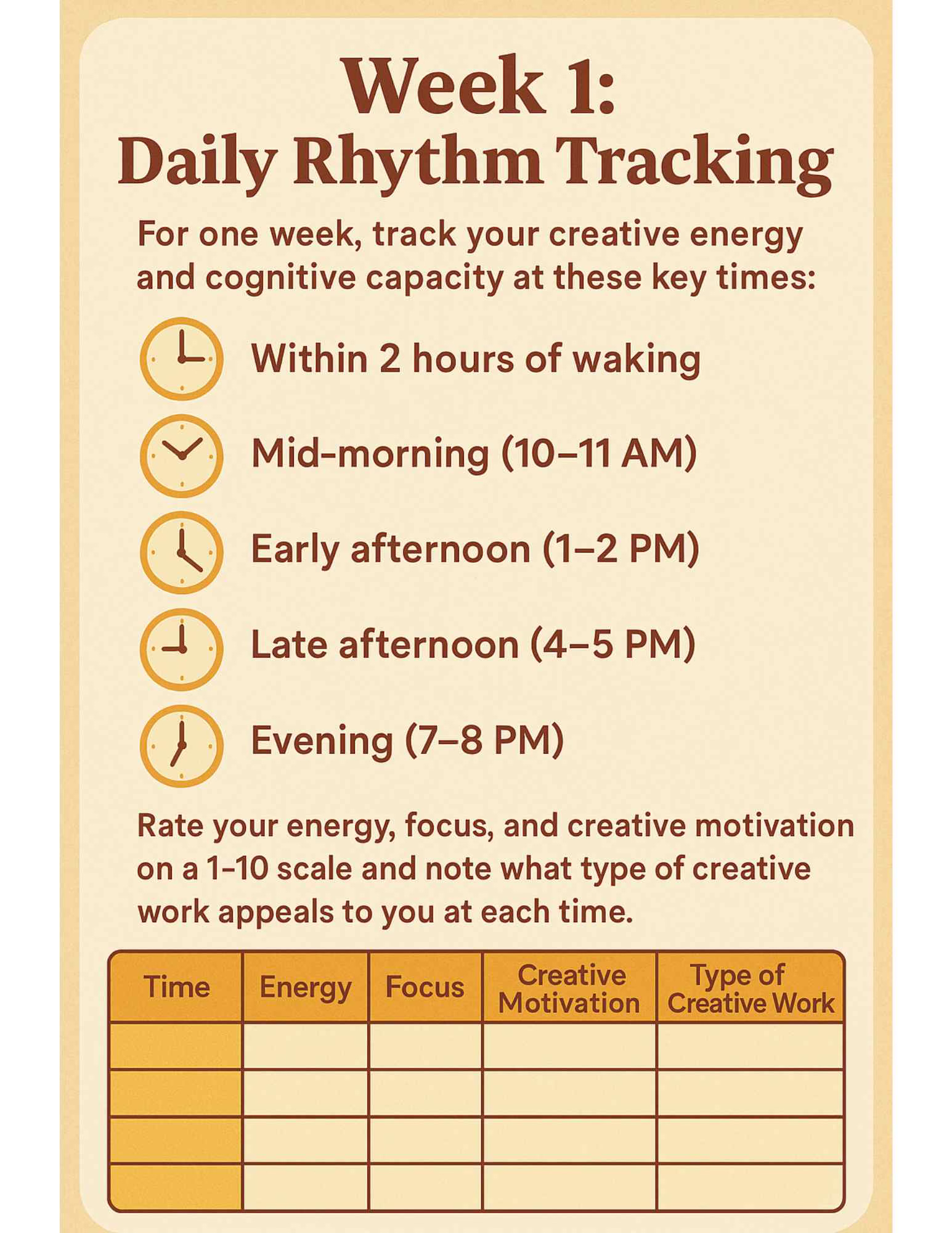
Creative Prime Time Exercise
This practice helps you identify and work with your natural creative rhythms:
Week 1: Energy Tracking
For seven days, rate your creative energy and mental clarity every two hours from when you wake up until you go to sleep. Use a simple 1-10 scale and note what type of creative work appeals to you at each time.
Week 2: Attention Quality Assessment
Pay attention to the quality of your thinking at different times:
When do ideas flow most easily?
When does problem-solving feel effortless versus effortful?
When do you feel most emotionally available for creative work?
When does creative work feel like pushing through mud?
Week 3: Output Quality Review
If possible, try doing the same type of creative work at different times of day and compare the results:
What differences do you notice in the quality or style of work produced?
Which times produce work that feels most authentic to your voice?
When does creative work feel sustainable versus draining?
Week 4: Protection Strategies
Based on your observations, experiment with protecting your optimal creative time:
What would need to change to honor your creative prime time?
How can you minimize distractions during peak creative hours?
What creative activities work well during non-prime times?
Small Shifts That Honor Your Creative Clock
Notice without judgment first. Before trying to optimize anything, simply observe your natural creative rhythms without labeling them as good or bad.
Protect your prime time from non-creative activities. Even if you can only protect one hour a few days a week, those sessions will likely be more productive than longer sessions at suboptimal times.
Develop strategies for non-prime creative time. Not all creative work requires peak cognitive performance. Figure out what you can accomplish during lower-energy periods.
Adjust your creative expectations based on your current capacity. Different times of day call for different types of creative engagement.
Release romantic fantasies about how creativity "should" look. Your authentic creative practice is the one that actually works for your real life and real brain.
Remember that rhythms can change. Life circumstances, health changes, and aging can all shift your optimal creative times. Stay flexible and responsive to these changes.
The Reality Behind the Romance
The funny thing about releasing my fantasy of late-night writing sessions is that I've become more creative, not less. When I stopped fighting against my natural rhythms and started working with them, my writing became more fluid, more focused, more authentically mine.
I still sometimes feel a little pang of envy when I read about writers who do their best work at midnight, fueled by solitude and darkness. There's still something romantic about that image, ridiculous though I know that is. But authentic creativity isn't about matching someone else's romantic ideal; it's about showing up consistently for the work in whatever way actually serves your real creative capacity.
Your creative prime time might be early morning, late night, or somewhere in between. It might be consistent or variable. It might fit cultural expectations about when creative work happens, or it might be completely idiosyncratic. None of this matters as much as learning to recognize and honor whatever rhythm actually supports your creative expression.
The most productive creative schedule isn't the one that looks impressive or matches cultural narratives about serious artists. It's the one that allows you to show up consistently for your creative work with the energy and attention your art deserves.
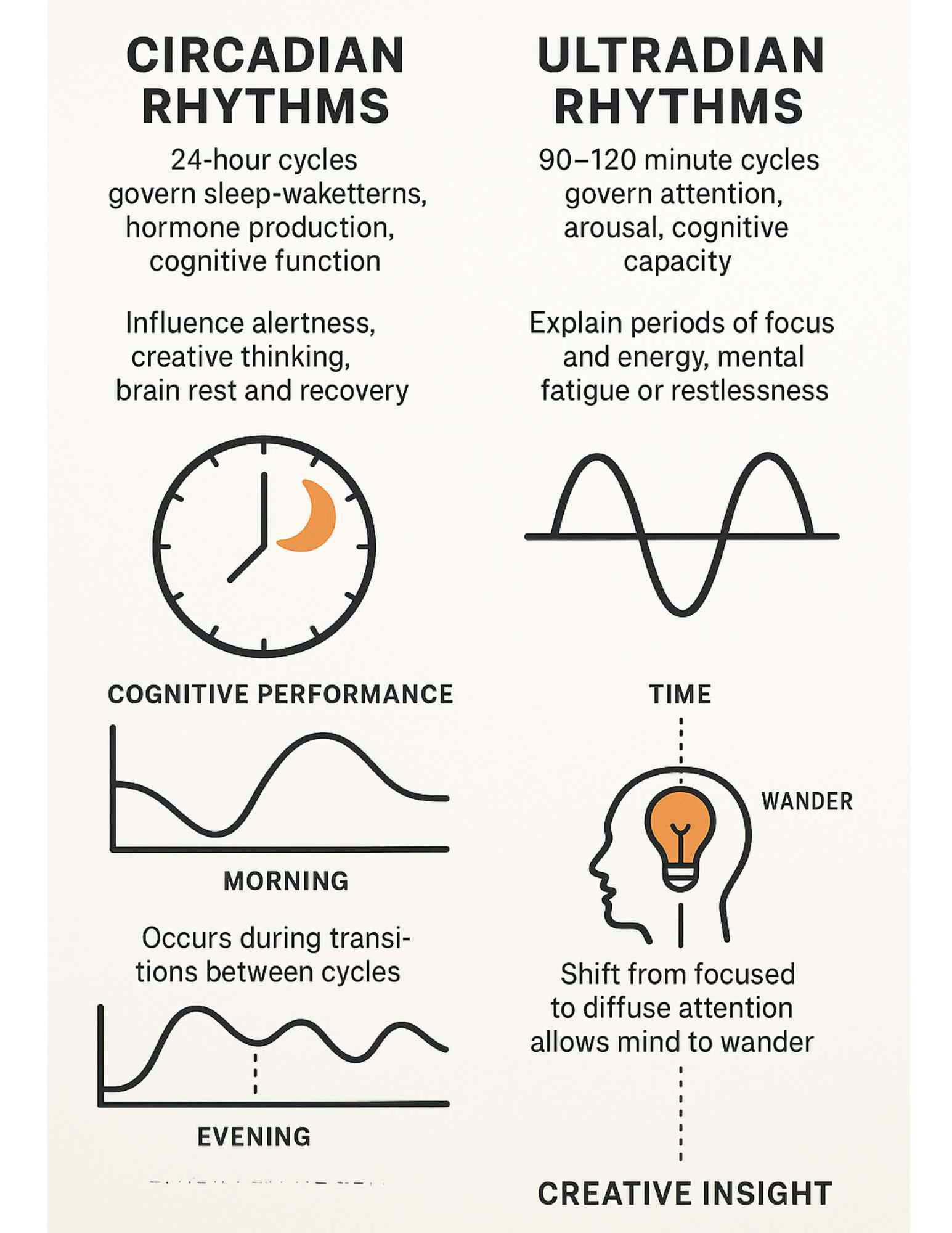
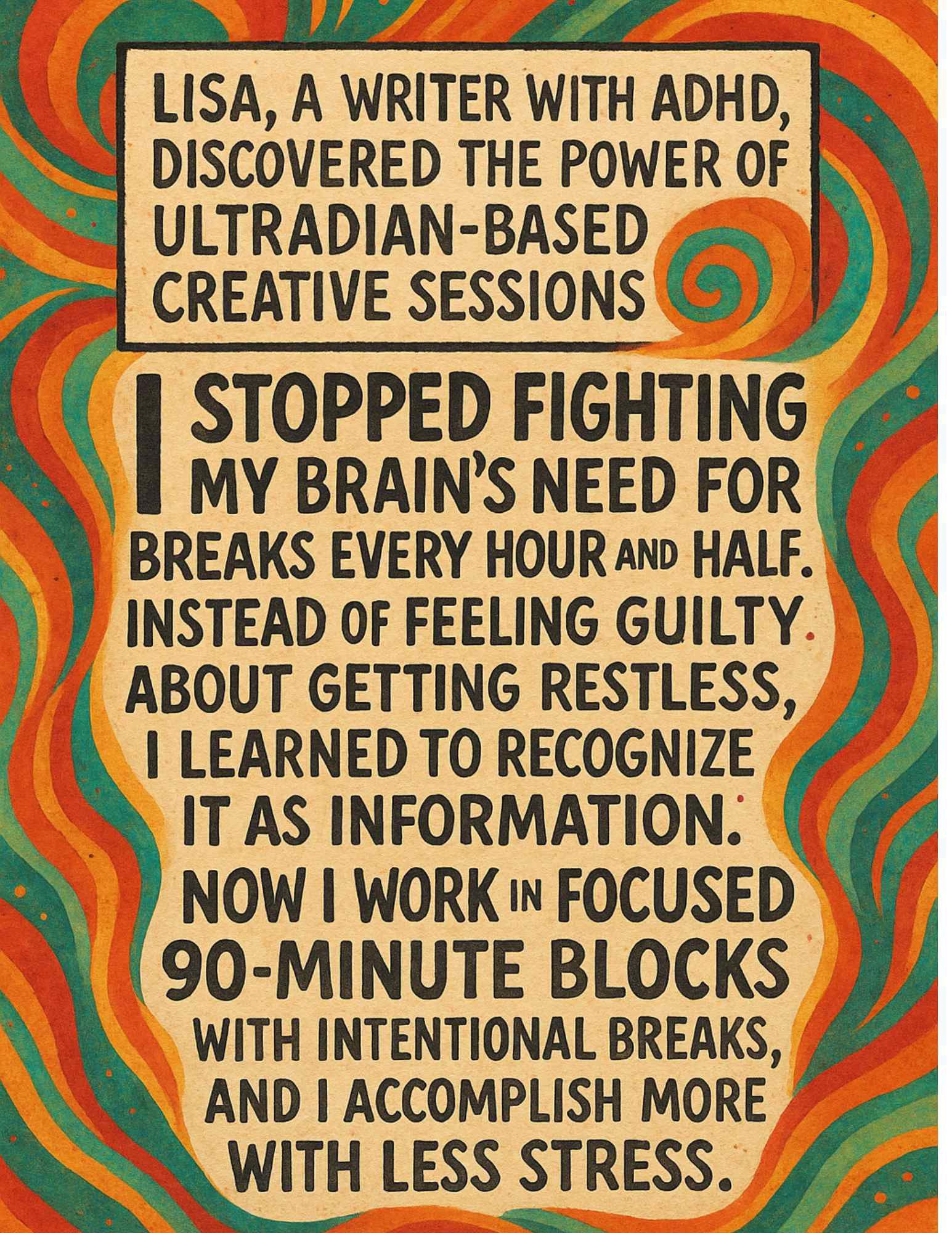
Want to deep dive into understanding circadian rhythms, ultradian rhythms, and what these things might tell us about our own best creative routines? There’s a comprehensive article over on Medium or you can download the same article in PDF form (you’ve seen sneak peeks of what’s in it from the images in this article) that is available for $5 here.


This was so helpful and educational, I don't think I'd heard of ultradian rhythms before! I'm slowly learning what works best for my own brain, and the less I try to force myself into a specific system or structure, the more ease I'm able to find. I'm definitely going to try the daily rhythm tracking.