
Sample Creative Health Map: Maya
I offer a unique Creative Health Mapping service that unfolds over five conversations to assist you in understanding the ways in which health and circumstance impact your creativity and, more importantly, how you want to navigate that terrain to live the creative life you most want.
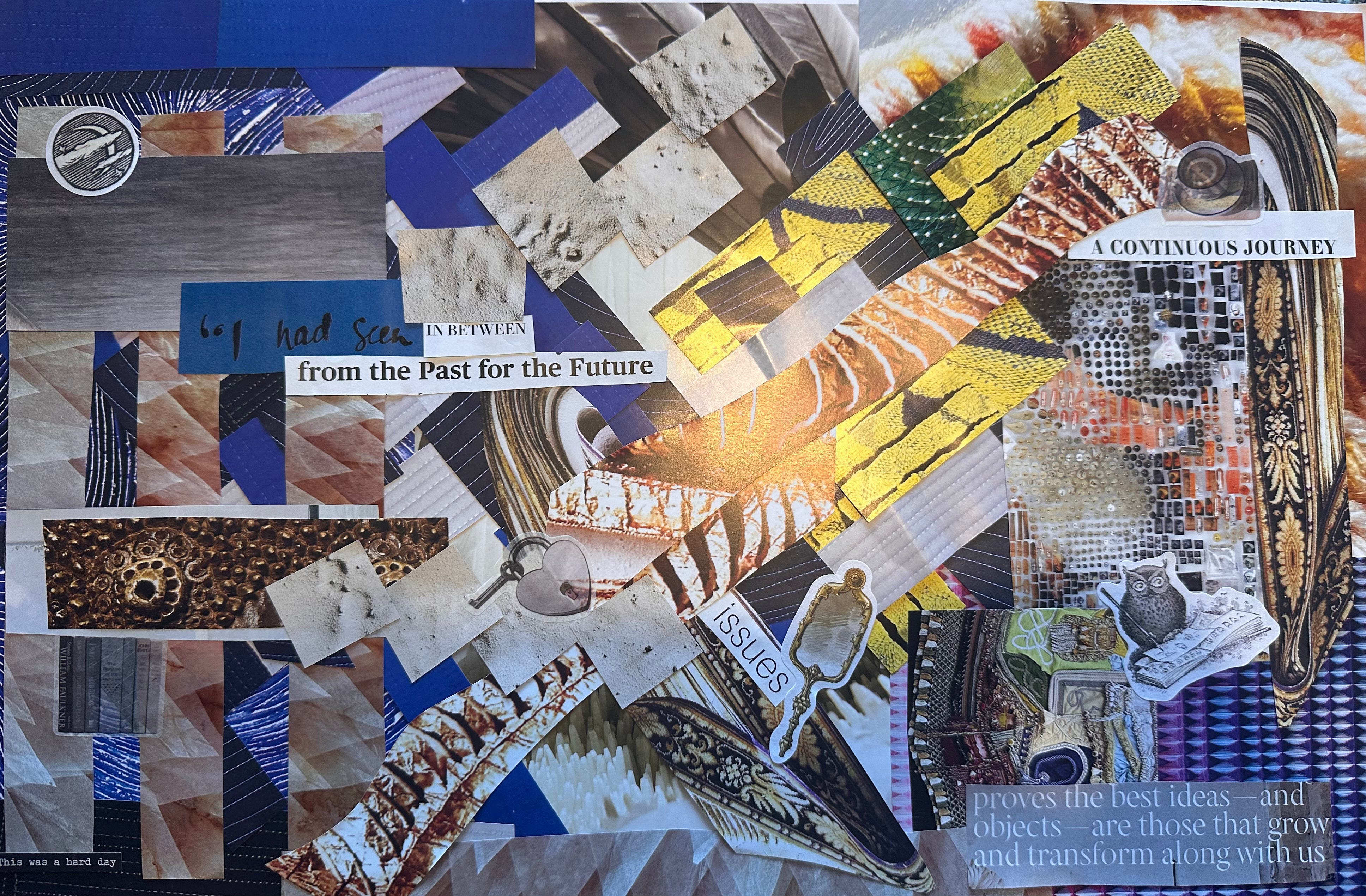
Part of this service includes both a written and visual map that I create for you after Session 2. I identify patterns, reflect back upon the language that you’ve shared and the implicit language I sense underneath, and create both of these. The written map is a report or reflection back to you that includes exercises/tips. The visual map is a handcrafted collage map that I create intuitively based on the sensory impressions I receive in our conversations.
Curious what this looks like? Here is a sample written and visual map provided for Maya (a composite client).
Maya’s Creative Health Map
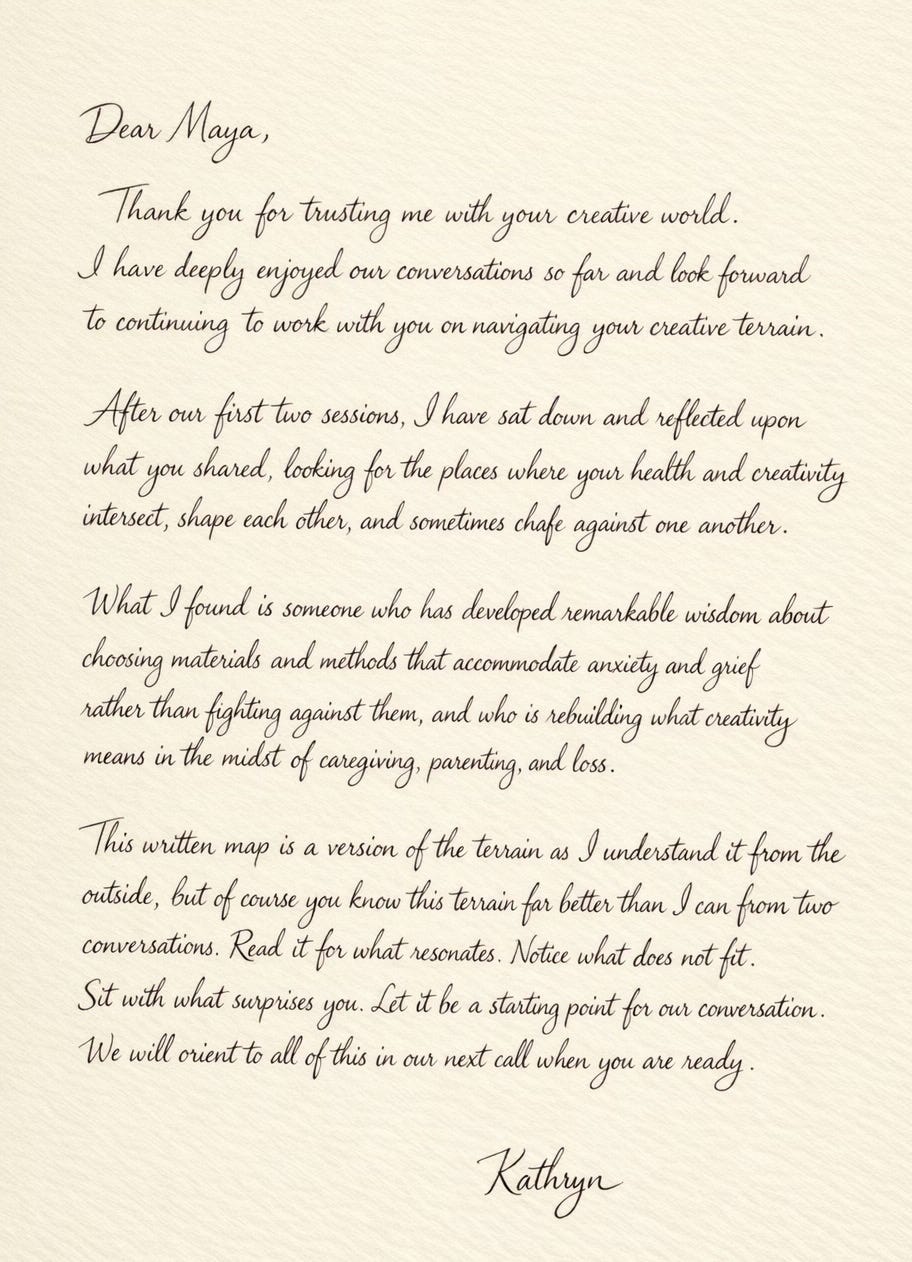
Dear Maya,
Thank you for trusting me with your creative world. I have deeply enjoyed our conversations so far and look forward to continuing to work with you on navigating your creative terrain.
After our first two sessions, I have sat down and reflected upon what you shared, looking for the places where your health and creativity intersect, shape each other, and sometimes chafe against one another.
What I found is someone who has developed remarkable wisdom about choosing materials and methods that accommodate anxiety and grief rather than fighting against them, and who is rebuilding what creativity means in the midst of caregiving, parenting, and loss.
This written map is a version of the terrain as I understand it from the outside, but of course you know this terrain far better than I can from two conversations. Read it for what resonates. Notice what does not fit. Sit with what surprises you. Let it be a starting point for our conversation. We will orient to all of this in our next call when you are ready.
Kathryn
You Are Here
You are a poet who has been making work for twenty-two years. That is a credential and a fact about who you are: the kind of person for whom the poem is a way of being in the world, alongside what you do. You also make collage, which is separate from the poetry to an extent, but it feeds it, gives it imagery, gives you a way to find the picture before you find the words.
Six years ago, fibromyalgia arrived and rearranged the conditions under which all of this is possible. The pain is the loudest thing sometimes but other times closer to background noise … More like “static underneath everything else” was your phrase that echoed for me. The nervous system that your creative work depends on is the same nervous system that chronic pain lives in; that is the central fact of your creative life right now.
You are at your desk. You can see the work. The lantern is in your hand. The water is right there. But you can’t seem to cross over into finding a way to create poetry and collage that makes sense for who you are now, including the needs you have as someone living with the effects of fibromyalgia.
What seems to be present is accumulated weight rather than an absence of ability or vision or intelligence: things sealed, things depleted, a self still being measured against a former self who no longer exists in the same form.
The Six Areas of Creative Health
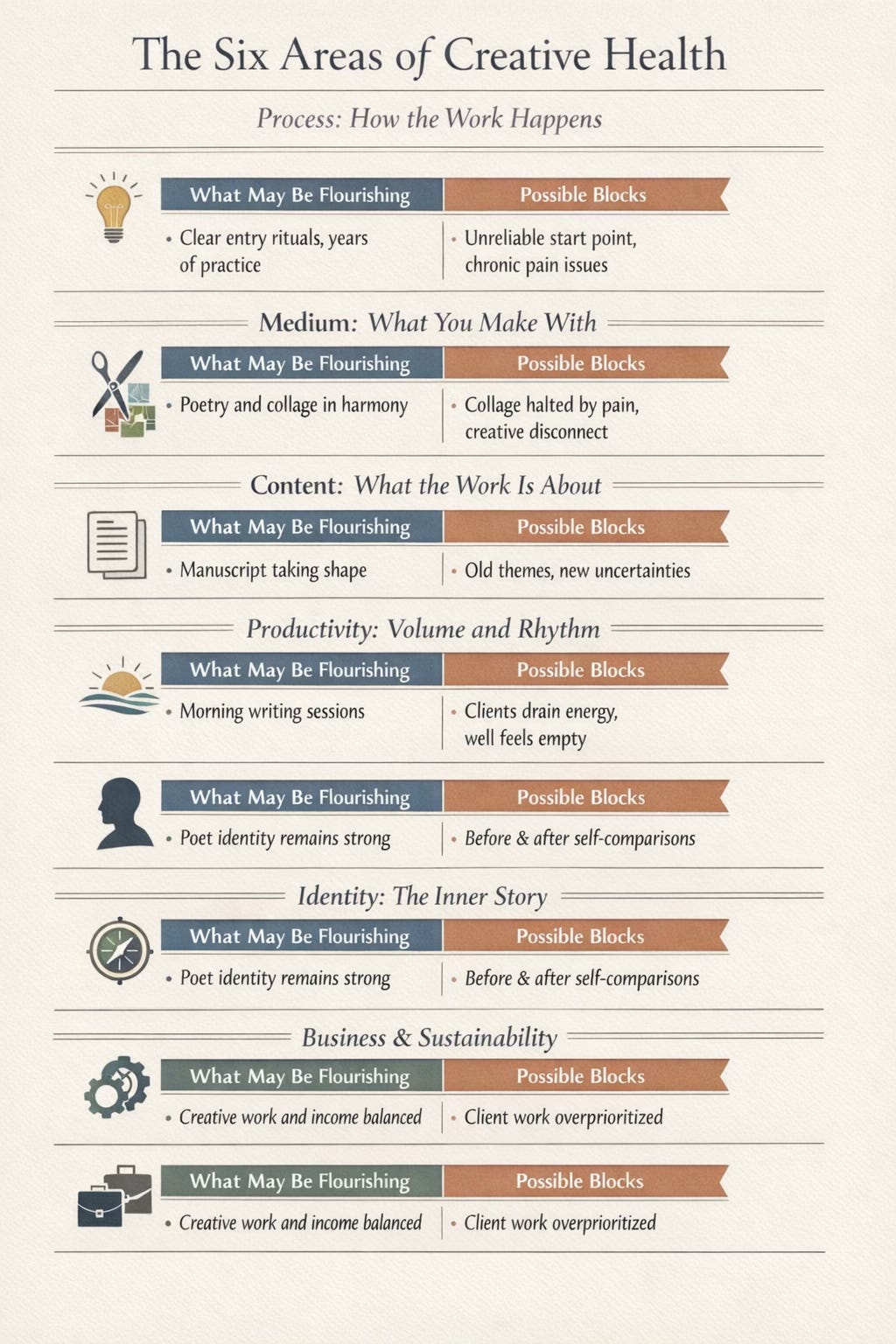
Process: How the Work Happens
What May Be Flourishing
You know exactly how you work. The fragment-based process, finding an image and living with it before writing into it, is a sophisticated and considered approach to poetry. It requires interior quiet and a particular quality of attention. That you know this about yourself, that you have twenty-two years of understanding how your process works, is a resource many poets do not have. Don’t underestimate it.
Possible Blocks
The threshold, the moment of crossing from outside the work to inside it, seems to have become unreliable. The nervous system that the crossing requires is the same one that chronic pain has made unpredictable.
What seems to be happening is that you have forgotten the way in. The conditions the work requires are no longer reliably available. That is a different problem with different possible responses. On the days when the body is available, the crossing is possible. On the days when pain arrives as static, the outside/inside distinction collapses and you are left standing at the edge. Naturally, this is frustrating and creates blocks in your work.
Medium: What You Make With
What May Be Flourishing
You have two mediums that sustain each other. Poetry and collage are one practice in two registers. The collage finds the image, the poetry finds the words. This is a unique creative arrangement and one of your particular strengths as a maker.
Possible Blocks
The collage practice has effectively stopped. The fine motor demands of cutting and placing became too painful and frustrating about four years into the fibromyalgia diagnosis. You put everything down and didn’t go back. The table has been “a sealed room” in your words.
What seems worth naming is that this closing has had a ripple effect that may not be fully visible: the collage was where you found your imagery. Without the table, the primary source of imagery for the poetry has also been closed. The well the poetry draws from has been sealed from another direction. So perhaps you will want to find a way to collage that works for you now or perhaps you’ll want to find another way into the imagery of poetry.
Content: What the Work Is About
What May Be Flourishing
You have a manuscript. You know what it wants to be. You can describe individual poems that belong in it. That clarity of vision for a whole collection is something every poet has access to, and you have it. The manuscript exists in your mind in its complete form. Celebrate that!
Possible Blocks
The manuscript was begun before the diagnosis. Some of what you consider to be its best work comes from the before. You have been sitting with a question: how to finish it as the poet you are now while honoring the poet who began it. The question of which self finishes it is the obstacle. An identity problem in writing-problem’s clothes.
What I am curious about: whether the poet you are now, the one with access to the interior world of illness and the knowledge that living in a changed body produces, might have something to add to this manuscript rather than something to compensate for.
Productivity: Volume and Rhythm
What May Be Flourishing
The morning window is when you can work. You named it with precision: the body is most available before pain escalates, and early light is when the work is most possible. That is knowledge about your own creative capacity, and it is actionable in a way that general aspirations about writing more are often not.
Possible Blocks
The freelance prose work for clients consumes the language first. By the time you arrive at your own desk, the “well is empty”. You described this with flat resignation, as if it were simply the cost of survival, and perhaps it is. It seems worth sitting with whether the arrangement has been questioned recently or whether the resignation has become its own kind of seal.
Identity: The Inner Story
What May Be Flourishing
You know you are a poet. That hasn’t changed. The certainty underneath the doubt, the fact that the question of whether you are still a poet is even painful enough to matter, is evidence that the identity is intact even while it is under pressure.
Possible Blocks
Six years ago a rupture happened. The poet before the diagnosis and the poet after feel like two people, and you have been holding those two selves separately for six years without naming that holding as the complicated heavy work it actually is.
You measure the work you make now against the work you made before. You suspect the comparison is unfair. You even suspect some of the current work may be better. You cannot trust that assessment because the measuring happens faster than the trusting.
What seems to be true is this: you haven’t been given permission to be the poet you became after the diagnosis rather than the poet you were before it. That permission is not something someone else can give you. And you might be finding it hard to give it to yourself right now. But it can be named, and naming it is usually where it begins.
Business and Sustainability
What May Be Flourishing
You have sustained a creative practice and a survival income through six years of significant health challenges. The freelance work, whatever its costs, has kept you writing, housed, and functioning. It sounds frustrating that it has so much of your healthy time, and it’s good to notice that, mourn that and find ways to shift it, but it’s also valuable to honor that you’ve done this.
Possible Blocks
The arrangement (freelance clients get your energy) seems to have been accepted rather than chosen. Whether that acceptance is accurate, whether the actual constraints are what they appear to be, is an area this map cannot assess fully from the outside. It is an area that seems worth returning to and exploring solutions for.
Cross-Area Patterns
None of the six areas of our creative terrain really exist in isolation. Here are some of the cross-area patterns I noticed in our conversations.
The Sealed Rooms
You used the word “sealed” and other words similar to it a lot. The collage table is sealed. The manuscript is sealed. The before and after is sealed. You have a pattern across several areas of sealing what is too painful to approach and then losing access to the resources those things contain. The collage table contained your imagery. The manuscript contained your most considered poetic voice. The before and after contains your permission to be the poet you actually are now.
The sealed rooms are protection, reached for when something needed protecting. It is absolutely necessary to protect ourselves sometimes, especially when first dealing with a diagnosis. What seems worth exploring is whether any of them are ready to be opened, and in what order, and in what company.
The Well and Its Sources
The empty well was an image you shared that really stuck with me. The depletion is about more than the freelance work although it starts there. The well is empty from multiple directions: the collage practice that used to replenish your imagery has stalled, the manuscript that used to give your writing direction feels old, and the creative identity that used to give you confidence is measured against a self that no longer exists. The freelance work takes from a well that several other things have also stopped filling. But there will be ways to refill that well.
The Measuring
You cannot stop measuring what you make now against what you made before. This measuring appears in how you enter the work, in what you believe about the manuscript, in how you assess your current poems, in how you understand your productivity. It is the cross-area pattern that amplifies every other block.
What seems worth noticing: you said yourself that some of the current work might actually be better. The measuring is giving you a consistent verdict rather than accurate information.
Summary of the Creative Landscape
Where You Are
Standing at the edge of the water with a lantern. The work is visible. The tools are in your hands. The body is unreliable and the well is low and the rooms you sealed are still sealed. You are close to the work but you are stopped at the threshold by accumulated weight that hasn’t been fully named. You are also here, doing this work, ready to navigate new terrain.
Where You Want To Be
A morning creative practice before anything else, waking up and spending the energy you have on the things that nourish you.
You want the manuscript finished, as the poet you are now, with whatever that version of you brings to it. This means that you would love to have the collage table open again, in some form the hands can manage.
“A practice that feels like mine.” You used that phrase. That is the destination.
What Is In Between
The chronic pain weather system, unpredictable and ever-present, which makes the threshold crossing unreliable and the well refilling slow. The sealed rooms: the collage table, the manuscript, the permission to be the current poet. The empty well, depleted from multiple directions. The measuring, which keeps the former self present as a standard the current self cannot meet. The last mile: you can see where you want to go clearly, but sustaining the focus long enough to cross the final distance has become its own obstacle.
Possible Helpful Practices
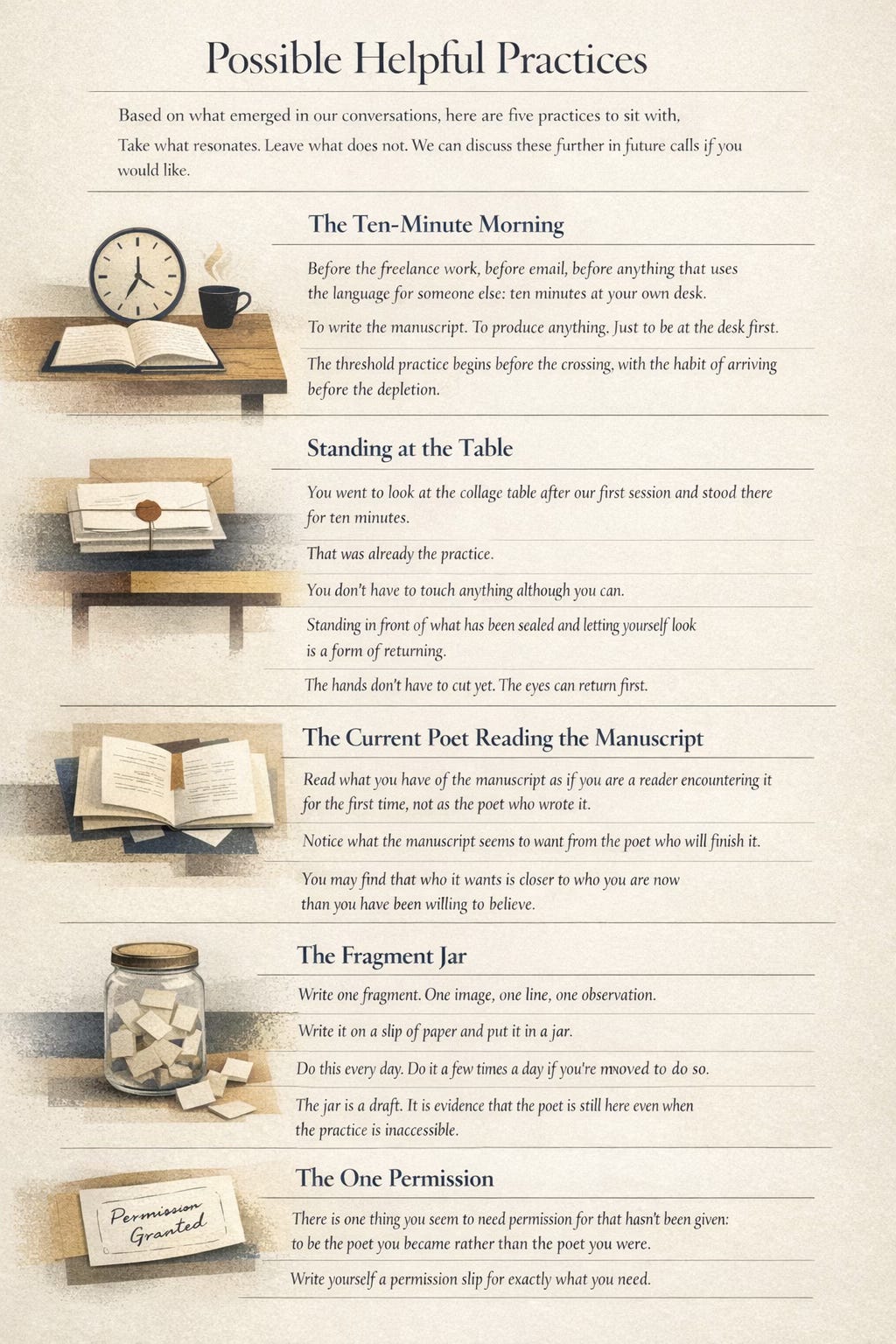
Based on what emerged in our conversations, here are five practices to sit with. Take what resonates. Leave what does not. We can discuss these further in future calls if you would like.
The Ten-Minute Morning. Before the freelance work, before email, before anything that uses the language for someone else: ten minutes at your own desk. To write the manuscript. To produce anything. Just to be at the desk first. The threshold practice begins before the crossing, with the habit of arriving before the depletion.
Standing at the Table. You went to look at the collage table after our first session and stood there for ten minutes. That was already the practice. You don’t have to touch anything although you can. Standing in front of what has been sealed and letting yourself look is a form of returning. The hands don’t have to cut yet. The eyes can return first.
The Current Poet Reading the Manuscript. Read what you have of the manuscript as if you are a reader encountering it for the first time, not as the poet who wrote it. Notice what the manuscript seems to want from the poet who will finish it. You may find that who it wants is closer to who you are now than you have been willing to believe.
The Fragment Jar. Write one fragment. One image, one line, one observation. Write it on a slip of paper and put it in a jar. Do this every day. Do it a few times a day if you’re moved to do so. The jar is a draft. It is evidence that the poet is still here even when the practice is accessible. The fragments can be read later, or not.
The One Permission. There is one thing you seem to need permission for that hasn’t been given: to be the poet you became rather than the poet you were. Write yourself a permission slip for exactly what you need.
What Comes Next
You have the written map in your hands. You also have a visual map arriving with this document. Sit with both before we meet again. When you are ready, you can schedule your orientation call here.
Session Three is the orientation session. We will walk through the map together. You will tell me what resonates and what does not, what I have gotten wrong, what surprises you, and what you might notice as impressions from the visual map. After that, we’ll have two more sessions in which we can navigate this terrain and work through the areas that feel most poignant for you.
The work is to see the terrain clearly enough that you can begin to navigate it in a way that is honest about what is actually there. You have already come so far in laying out the terrain where we can see it. I look forward to navigating it with you.
Kathryn
Note: Maya is a composite client. This was built primarily from the experience of mapping with one client who gave me permission to share with identifying details changed. I included additional information incorporated from three other clients to further anonymize the original.