
Health and Creative Medium: What the Dominant Conversation Leaves Out
The health layer in medium choice shapes what artists can make at least as much as aesthetic preference does. Here is what that layer contains.

Creative culture talks about medium almost entirely in aesthetic terms. The painter loves what oil does on canvas. The fiction writer loves what the form allows with time and interiority. The ceramicist loves what clay does under the hands. These preferences are real, they shape the work, they are an important part of the conversation. But they aren’t the only part.
What about health? The relationship between health and creative medium shapes what artists can make at least as much as aesthetic preference does, and it is almost entirely absent from the way creative culture discusses medium choice. The result is that many artists are navigating a significant and consequential part of their practice in relative isolation, without language for what they are experiencing and without a framework for understanding why their relationship with their materials keeps shifting.
You already have the answers to unblocking your creativity. Find them with the help of a Creative Health Map.
What the Tools You Reach For Are Already Telling You
Medium choice tends to be discussed as a conscious decision: you chose this material because of how it behaves, this form because of what it allows. What the research on creative practice consistently shows is that the relationship runs in both directions. The tools artists reach for also reveal something about the state they are in, and the materials that become available and unavailable during different health periods track health in ways that tend to be visible in retrospect and invisible in the moment.
The artist who keeps returning to a specific material during difficult periods, who finds herself reaching for fiber or a sketchbook or a particular kind of mark-making when her health is most challenged, is responding to something real in the sensory and physical properties of that material. The tools you choose communicate with the nervous system before you have consciously assessed anything. Understanding that this communication is happening makes it available to deliberate attention rather than only to instinct.


What Health and Creative Medium Actually Mean Together
The concept of affordances, developed by psychologist James Gibson, describes what an environment or object makes possible for a particular actor based on that actor’s specific capacities. A set of stairs affords climbing for a person with full mobility and affords an obstacle for a person using a wheelchair. The same physical object; entirely different affordances based on who is approaching it.
Health and creative medium work in exactly this relationship. A particular medium affords certain kinds of creative engagement for an artist whose body is in a specific state. When health changes the body’s capacities, the affordances of the same medium change without the medium itself changing at all. The oil paint that afforded sustained, precise, extended creative engagement during a period of full health affords something significantly different when a chronic pain condition has reduced stamina and fine motor precision. The medium is identical. The affordance relationship has shifted entirely.
This is the most precise account of why health changes medium access in ways that have nothing to do with skill or commitment. The artist has the same knowledge, the same training, the same aesthetic judgment. What has changed is the body that is meeting the medium, and the meeting produces a different set of possibilities as a result.

What the Body In Pain Already Knows
Artists navigating physical pain in their creative practice are navigating a medium relationship that is shaped at every level by that pain: what postures are sustainable, what duration of physical engagement is possible before the cost outweighs the work, what fine motor demands exceed what the day has available, what sensory experiences the nervous system can tolerate.
What artists in this situation tend to discover, often through a period of difficulty, is that the medium relationship has to be renegotiated around what is actually available rather than around what was previously accessible. The renegotiation tends to surface a much more specific understanding of what the medium requires and what the body can offer than the uncomplicated relationship ever demanded. An artist who has had to think carefully about what her materials require of her hands has a different and often deeper understanding of the hand-material relationship than an artist who has never had to examine it.
The renegotiation is costly. It also tends to produce knowledge that ease does not generate.


What Yayoi Kusama’s Practice Illuminates About Medium and Health
Yayoi Kusama began covering surfaces in obsessive, repetitive dots as a young artist in Japan, driven by visual hallucinations and compulsions she described as being unable to stop. The dots were, from the beginning, simultaneously a symptom and a method: the act of covering the surface with the pattern provided a specific kind of relief from the visual experience the hallucinations produced. She made work that mirrored and responded to her perceptual experience, and the making itself was regulatory.
What Kusama’s practice demonstrates is that the relationship between health and medium can be generative rather than only constraining. The specific medium she developed, the obsessive mark applied at the specific scale and density her neurological experience required, produced a body of work that is formally distinctive in ways directly connected to the health experience that shaped it. The dots are not despite the condition. They are the condition expressed as methodology.
This is not an argument that health challenges are secretly advantages and we should celebrate them. They are challenges, they carry real costs, sometimes we have to mourn that. But it is an observation, nonetheless, that the medium relationship shaped by health tends to carry the marks of that shaping in the work itself, in ways that give the work a specific and irreducible character.
What Redefining Success Looks Like When Health Sets the Terms
The standards by which creative success tends to be measured (output volume, consistency, the ability to sustain a practice across extended periods at the same level of engagement) were developed without reference to fluctuating health. They describe the creative life of a person with stable capacity, and they function as evaluation criteria for everyone else.
Artists navigating chronic illness, mental health challenges, or other conditions that significantly affect capacity have often had to develop their own criteria: measuring the practice by its continuity rather than its output, by what it does for the body and the self rather than by what it produces, by the quality of the relationship with the work rather than by the quantity of the work produced. This is a form of self-knowledge that the standard criteria actively prevent, because the standard criteria consistently tell the story of failure rather than the story of a practice navigating real conditions with real intelligence.
What health asks of creative practice, when taken seriously, is a renegotiation of what success means. That renegotiation tends to produce a more honest and more sustainable relationship with the work than the uncritical adoption of external standards would ever have generated.

Understanding your own relationship to creative states through a health lens is what Creative Health Cartography is designed to support through mapping and navigation sessions.
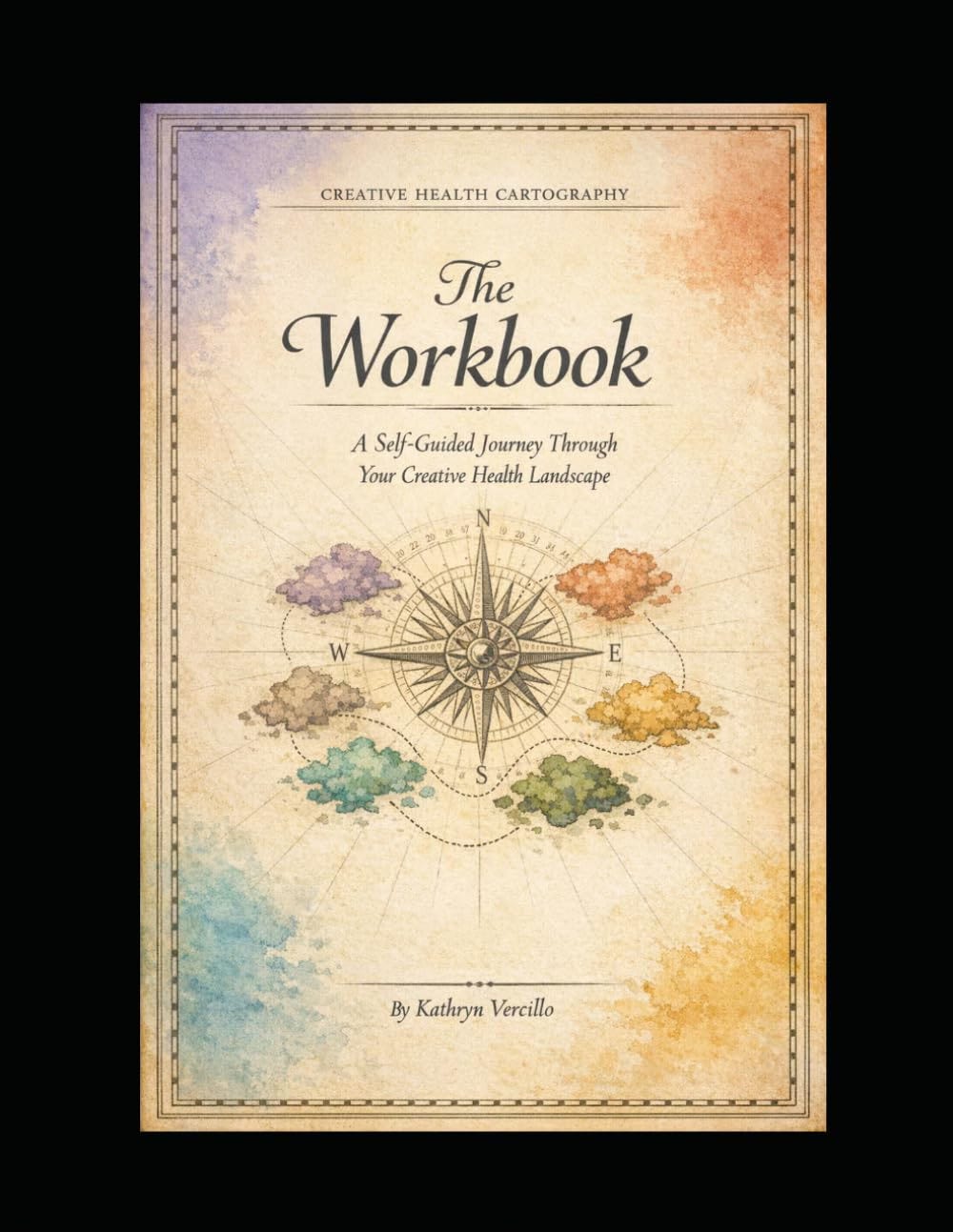
Would you rather explore this on your own? My Creative Health Cartography Workbook is a great place to start.
Writing from others:
With gratitude for the words you share to Kelly Feltault BFA, CTAP, PhD, GraphicMemoirBlog, Frances Rhodis, Ali Liebegott via Sari Botton, and KMBennett


Thank you so much for including me in this amazing group of artists and your spot on post. I feel we are starting something here on Substack
Thanks for sharing