
Dear Artist Whose Body Hurts When You Create
On adaptation as a creative act, and why the work you make within your limits is not lesser work

Dear artist whose hands ache after an hour of work,
Dear writer whose neck and shoulders have become a permanent knot of tension,
Dear musician whose wrists send warnings you’ve learned to ignore,
Dear maker who has to ice something, heat something, stretch something every time you create,
Dear craftsperson who grieves the hours your body used to give you without complaint,
Dear creative whose relationship with your tools now includes negotiation with pain,
This is for you.
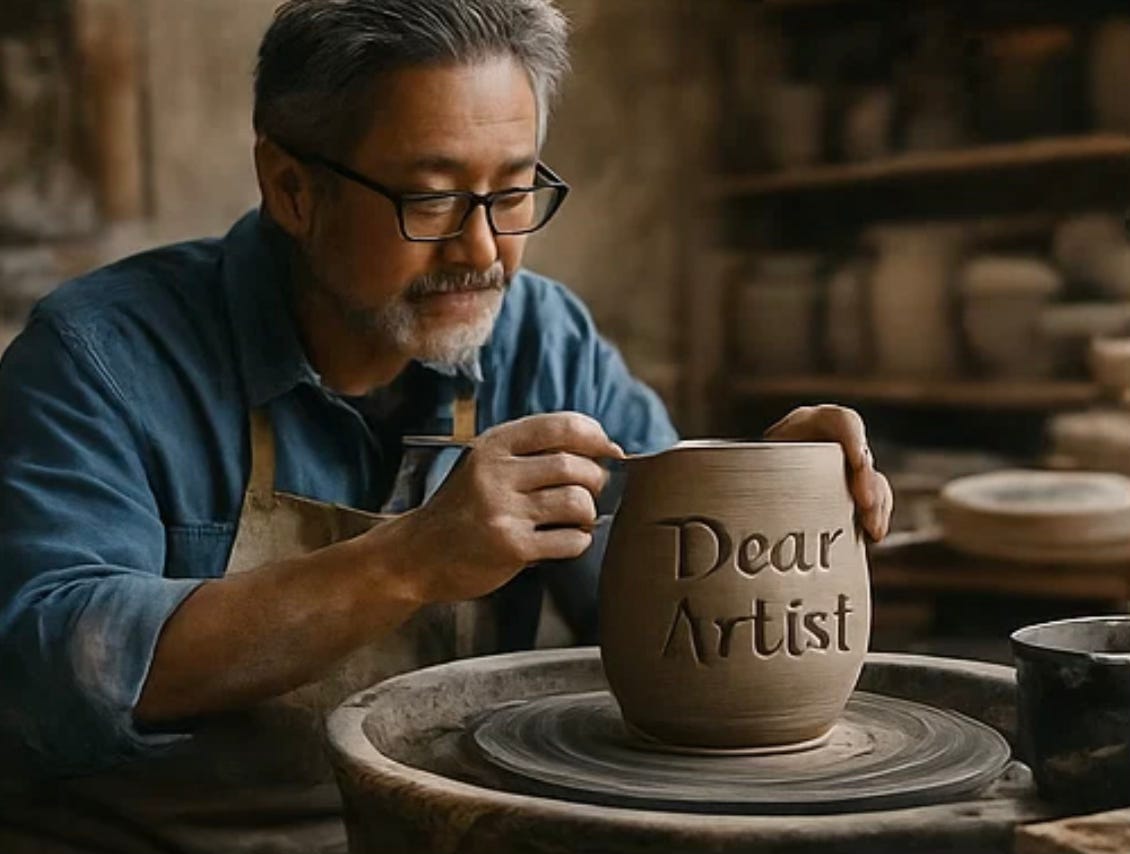
It is a particular kind of loss, creating through a body that resists the very act of making. You remember, perhaps, when your hands could work for hours without consequence. When bending over a project didn’t mean paying for it the next morning. When the only limit on your creative time was the clock, not the growing ache that forces you to stop before you’re ready.
That was then. This is now. And now requires a different kind of relationship with your work.
Please hear this first: the pain is real, and it matters. You are not being dramatic. You are not weak. You are not failing at being an artist because your body has limits that other bodies might not share. Chronic pain, repetitive strain, inflammation, nerve issues, autoimmune conditions, injuries that never fully healed: these are not character flaws. They are physical realities that you are navigating while still trying to make your art. That navigation takes energy that other artists may not have to spend. Give yourself credit for that.
The world of creative advice often assumes a body that cooperates. Tips about building daily practices, about pushing through resistance, about showing up no matter what. And while there’s wisdom in some of that advice, it can feel alienating when your resistance isn’t mental, it’s physical. When showing up means showing up to pain. When the daily practice has to include recovery time that others don’t need to build in.
What would it mean to honor your body’s communication rather than override it?
Pain is information. It is not punishment, and it is not failure. It is your body telling you something about what it can and cannot sustain. The question becomes: how do you create within those limits rather than despite them? How do you work with your body instead of against it?
This might mean shorter sessions. It might mean more breaks. It might mean different tools, adapted techniques, modified positions. It might mean letting go of the way you used to work and finding a new way that your current body can sustain. This is not giving up. This is adapting. And adaptation is one of the most creative acts there is.
Some artists who create through pain have found that the constraints actually shaped their work in unexpected ways. The forced pauses became moments of reflection. The need to work more slowly became an opportunity for more intentional choices. The physical limitations became a frame within which new creative solutions emerged. This isn’t about finding a silver lining in suffering. It’s about recognizing that your circumstances, whatever they are, become part of your creative context. You make art from where you are, with what you have, in the body you currently inhabit.
You might need to grieve what your body used to be able to do. That grief is valid. It’s okay to be angry about it, sad about it, frustrated by the unfairness of it. You didn’t choose this. You might have done everything right and still ended up with a body that makes creating harder than it used to be. There’s no lesson in that, no cosmic purpose. It’s just what happened. And you’re allowed to feel however you feel about it.
But you are also allowed to keep making things. The pain doesn’t disqualify you from being an artist. It changes the terms, but it doesn’t cancel the contract. You can be both: a person in pain and a person who creates. Those two truths can coexist.
What would help? That’s not a rhetorical question. It’s worth actually answering, specifically and practically. Do you need different seating, different lighting, different grip aids? Do you need to work in smaller increments with more frequent rest? Do you need to explore voice-to-text, or larger brushes, or tools designed for hands that hurt? Do you need to ask for help with parts of the process you can’t do comfortably alone?
The adaptations aren’t admissions of defeat. They’re acts of creative problem-solving applied to your own practice. They’re you refusing to let pain have the final word on whether you get to make things.
Sometimes the pain is too much, and you have to stop. Sometimes you have to take days or weeks or longer away from making. Sometimes the flare wins and you can’t create at all, no matter how much you want to. Those times are also part of being an artist in a complicated body. Rest is not laziness. Stopping is not quitting. Sometimes not creating is the most creative thing you can do for your future self, because it’s what allows you to create again later.
You know your body better than anyone. You know its patterns, its warning signs, its good days and bad days. Trust that knowledge. You don’t have to push through every barrier. You don’t have to earn your identity as an artist by suffering for it. The work you make within your limits is not lesser work. It is simply your work, made by you, in your circumstances.
I see you showing up to create even when it costs you something. I see the courage in continuing. I see the creativity required just to figure out how to keep going when your body makes it hard.
You are an artist. The pain doesn’t change that. What changes is how you practice, not whether you are.
With deep respect for what you carry,
Kathryn
Are you a creative with a body that needs some attention?
Check out Movement for Makers, “Yoga and mindful movement (class) to release tension, spark clarity, and support your creative flow.”
This virtual class is run by a friend I admire and trust whose attention to the needs of her own body as a maker is the root inspiration for sharing this knowledge with others.
Use the code FLOWFORFREE to get your first class free.
Read More:
Moving Beyond Limits: How Artists Transform Motor Challenges into Creative Innovation

Movement is the hidden language of artistic creation. Every brushstroke, every clay manipulation, every pencil line emerges from complex coordination between intention and motor execution. When injury, illness, or progressive conditions alter this fundamental relationship, artists face more than technical challenges … we encounter questions about identity, capability, and creative authenticity.
Redefining Success as a Chronically Ill Artist

I want to offer something different. I want to talk about what success can mean when you are living in a body that interrupts. I want to ask what success looks like when it is defined not by output, but by integrity. Not by pace, but by presence.
And I want to start with something I know personally:
Chronic illness doesn’t make you less creative. But it does ask you to get very honest about what creative life is actually sustainable.

Yes, so well articulated that I relate to this with my own experience. Juggling is my art, and offers many lessons on being flexible in finding a rhythm that suits my body with muscular dystrophy.
This is so hard. And with unpredictable health issues, it's hard to make adaptations. Thank you for articulating this