
Adaptation as Creative Intelligence: What Artists Learn When Constraint Forces a New Direction
Creative adaptation and health are more connected than most discussions of constraint acknowledge. What forced medium change produces that chosen change cannot.

There is a distinction to make between adaptation as consolation and adaptation as creative intelligence. The consolation version arrives too quickly at resolution, skipping over grief and dishonoring both the loss and the real discovery that eventually comes. It says the new practice is fine, the loss was secretly a gift, everything works out, when what is actually happening is an avoidance of the texture of the change.
Creative intelligence is different. It is the earned knowledge that develops when a constraint forces a real renegotiation with a medium, and when the artist is present enough to register what the renegotiation produces rather than simply surviving it. The constraint does the forcing. The presence does the registering. Together they generate understanding about the creative practice that the comfortable version never had to surface.
This piece looks at what creative intelligence is, where it comes from, and why creative adaptation under health constraints tends to produce it.
You already have the answers to unblocking your creativity. Find them with the help of a Creative Health Map.
What Constraint Actually Forces
When health forces a change in the medium relationship, whether that change is in the physical demands the medium can make, the scale or duration the body can sustain, the tools that remain available, or a move to a different medium entirely, what the change forces is a ground-level renegotiation with the question of what the creative work actually requires.
The artist who can no longer work in the way she has worked has to ask, sometimes for the first time in years, what the medium is for. What it offers. What it requires. What can be maintained in a different form and what is inseparable from the physical relationship that has become less available. These questions are rarely abstract. They land in the studio and ask for answers the practice has to produce through continued making, through trial, through attention to what this body and this material can still do together.
The philosopher John Dewey, in Art as Experience, argued that a work is completed in the encounter between the work and the perceiver, and that the making itself is an ongoing encounter between the artist and the material as it resists and responds. The material is never passive. It is always doing something, and the artist is always answering. What constraint does, when it enters this exchange, is make the material’s side of the conversation louder. The easy path narrows, and the artist has to hear what the medium is offering rather than what habit had been extracting from it.
Creative intelligence develops here. In the hearing. In the answering. The earned knowledge the unconstrained practice never had to surface is the content of what the medium has been saying the whole time, made audible by conditions that forced the artist to listen.


Why Creative Adaptation and Health Belong in the Same Conversation
The disability studies scholar Rosemarie Garland-Thomson writes about what she calls misfitting. A misfit, in her framing, is the friction that arises when a body encounters a world, or a tool, or a medium, built for capacities the body does not share. The encounter produces something. Sometimes difficulty. Sometimes creative problem-solving of a kind the comfortable fit never asked for. Often both at once.
Garland-Thomson’s insight is that the misfit is productive. The friction is data. The body that has to figure out how to do this thing in this world with these capacities ends up learning something about the thing, the world, and itself that the well-fitted body has no occasion to learn. That knowledge is the misfit’s contribution. It is also the beginning of creative intelligence as the opening of this piece described it.
When health creates a misfit between a body and its medium, the friction starts doing its work. The artist who has had to think carefully about what her medium asks of her hands has a different and more accurate understanding of the hand-material relationship than an artist who has never had to examine it. The painter whose arms tire sooner than they used to has studied, through continuing to paint, where the real demands of the practice sit. The textile artist managing chronic pain has developed, through continued making, a kind of attention to her own process that an uninterrupted career never has to produce.
This is where disability justice frameworks and creative practice intersect in ways that still get underread. The scholar Alison Kafer, in Feminist, Queer, Crip, argues that disability is a political and relational category, shaped by the environments and expectations that surround the body, rather than a simple lack in the body itself. Applied to creative work, this means the so-called limitation of a disabling condition is often the meeting point between a body and a practice designed around different capacities. The adaptation is the artist building a practice that fits her actual body rather than inheriting one built for a different body entirely.
The adaptation that looks like a lesser version of the original is, under closer examination, the original practice reorganized around knowledge that ease had never required. Creative intelligence and creative adaptation turn out to be the same movement.

What Breath Has to Do With Medium
The body’s respiratory state is one of the most underacknowledged factors in the relationship between health and creative medium. Anxiety-driven shallow breathing produces a condition of low-level physiological activation that makes the quality of presence many mediums require harder to access. The painter who finds that her most difficult sessions begin with a physical sense of tightness in the chest has often found that attending to breath before and during the session changes what is available from the medium, in ways that have nothing to do with skill or aesthetic judgment.
The polyvagal researcher Stephen Porges has described how the nervous system moves among states of activation, regulation, and shutdown, and how the breath both reflects and shapes the state the body is in. Slow exhalation signals to the nervous system that the environment is safe, and the body comes out of defensive activation into a condition where attention can land. For the artist, what this means practically is that the nervous system arriving at the canvas shapes what the canvas can be to her on that day. A body in activation encounters a jittery medium. A body in regulation encounters a medium that can hold. The materials are identical. The artist, in a felt sense, is encountering a different medium.
This is the opposite of a productivity technique. It is the recognition that the body arriving at the medium carries a physiological state into the encounter, and that the physiological state shapes the affordances of the medium as surely as physical capacity does. The medium changes according to who is meeting it.
Somatic practitioners, from Eugene Gendlin’s work on focusing to the body-based psychotherapies that followed, have long described a related phenomenon: that the body knows things before the cognitive mind catches up, and that a slower, fuller breath creates the room for that knowledge to arrive in language. Transferred into the studio, the implication is that the artist who attends to her own breath is preparing the ground for the medium to speak and for her to hear it.
Creative adaptation that works, in this light, includes attending to the bodily state being brought to the medium, alongside adapting the medium to the bodily state. Both directions of the relationship have something to offer. Both feed the creative intelligence the piece opened with: the knowledge that comes from being present to what is actually happening in the encounter between this body, this day, and this material.


What Goya, Faith Ringgold, and Others Show About Constraint
Francisco de Goya became progressively deaf from his mid-forties onward. His late-period works, the Black Paintings he executed directly onto the plaster walls of his own house, represent a full departure from the commissioned canvases of his earlier career. The materials, the surface, the scale, the process, the absence of any anticipated audience, all changed at once. What the conditions of his life produced was work of a kind he had never made before, organized around a different relationship with the medium and the act of making altogether. The Black Paintings are dark, private, unmannered, uninterested in approval. They could have come from no earlier period of his practice, because no earlier period was living under these conditions.
Faith Ringgold’s decision to work in quilts, beginning in 1980, was driven in part by the practical reality that large-format canvas paintings were difficult to transport and show in the way her work required, and in part by her deepening engagement with the African American quilt-making traditions she had grown up among. The quilt format solved a logistical problem. It also produced the work she is most known for: story quilts that combine painting, quilted fabric, and written text in a form inseparable from the conditions that generated it. The adaptation produced more than a lesser painting practice. It produced something the painting practice on its own could never have arrived at.
Both older and more recent examples repeat the pattern with different materials. Henri Matisse, bedridden in the final years of his life after cancer surgery, invented the cut-out as a full body of work, using scissors and painted paper when the easel and brush were beyond the reach of where his body was. The cut-outs are now considered some of the most inventive work of his career, and Matisse himself described them as a second life in painting rather than an ending of the first. Frida Kahlo, painting from the bed her injuries confined her to, with a specially designed easel and a mirror fixed to the canopy, developed the psychological self-portraiture she is known for because those were the conditions she was painting from. Claude Monet’s late water-lily paintings, made as his cataracts progressively altered his vision, carry the color changes of the failing sight into the work itself, producing the near-abstract luminosity of the Orangerie panels.
None of these are triumph stories. None of these artists would be likely to say the loss was a gain in disguise, or that the constraint turned out in their favor. What the work says, read carefully, is that constraint forced a full renegotiation with the medium, and the artists who renegotiated with attention produced work the pre-constraint practice could never have generated. The creative intelligence in the work is the intelligence the renegotiation built. It belongs to the conditions of its making, and the conditions included the constraint.

What Unfamiliar Materials Teach About Presence
The relationship between a medium and the artist’s nervous system becomes most legible when the medium is newly encountered. For example, artists who have experimented with neon, a material that demands sustained attention to a physically demanding and materially unforgiving process, often describe a quality of presence in the making that their established mediums had organized into automaticity. The neon demands full attention at every moment. There is no autopilot available. The demand, for artists used to more forgiving materials, produces a quality of creative engagement that the familiar practice had long since stopped asking for.
The phenomenon generalizes. An oil painter who picks up stone carving, a digital illustrator who moves to letterpress, a fiber artist who learns metal soldering, describes a similar re-entry. The muscle memory is gone. The intuitive sense of how the material will behave is gone. What is left is the artist, present, paying attention to what this material is doing in this moment, answering as she goes. The anthropologist Tim Ingold, in Making: Anthropology, Archaeology, Art and Architecture, argues that making is always a correspondence between the maker and the material as it unfolds, and that habitual practice tends to cover over this correspondence under the smooth surface of expertise. The unfamiliar material strips the covering away. The correspondence becomes visible again because the maker has to see it.
This is one of the through-lines creative adaptation and health share. Both force the artist into presence because the comfortable pathway has become unavailable. Whether the constraint comes from the body, from a new material, or from conditions that changed mid-career, what the constraint produces is the artist having to be entirely with what the medium is doing and what the body has available. The habits that used to manage the process can no longer do their managing. The artist has to be there.
Creative intelligence, as the opening described it, is the knowledge that develops in exactly these conditions. It is the knowledge that develops when the automatic pathway closes and the artist has to meet the medium awake. Whether the closing comes from health or from a new material, the presence the closing forces is what generates the intelligence. The conditions produce the intelligence. The intelligence then belongs to the work.

The intelligence that develops through forced creative adaptation belongs to the experience of having been constrained. It cannot be reverse-engineered from outside. It has to be built in the practice and then recognized once built. That recognition, and what to do with it, is the kind of pattern work that Creative Health Cartography is designed to support through mapping and navigation sessions.
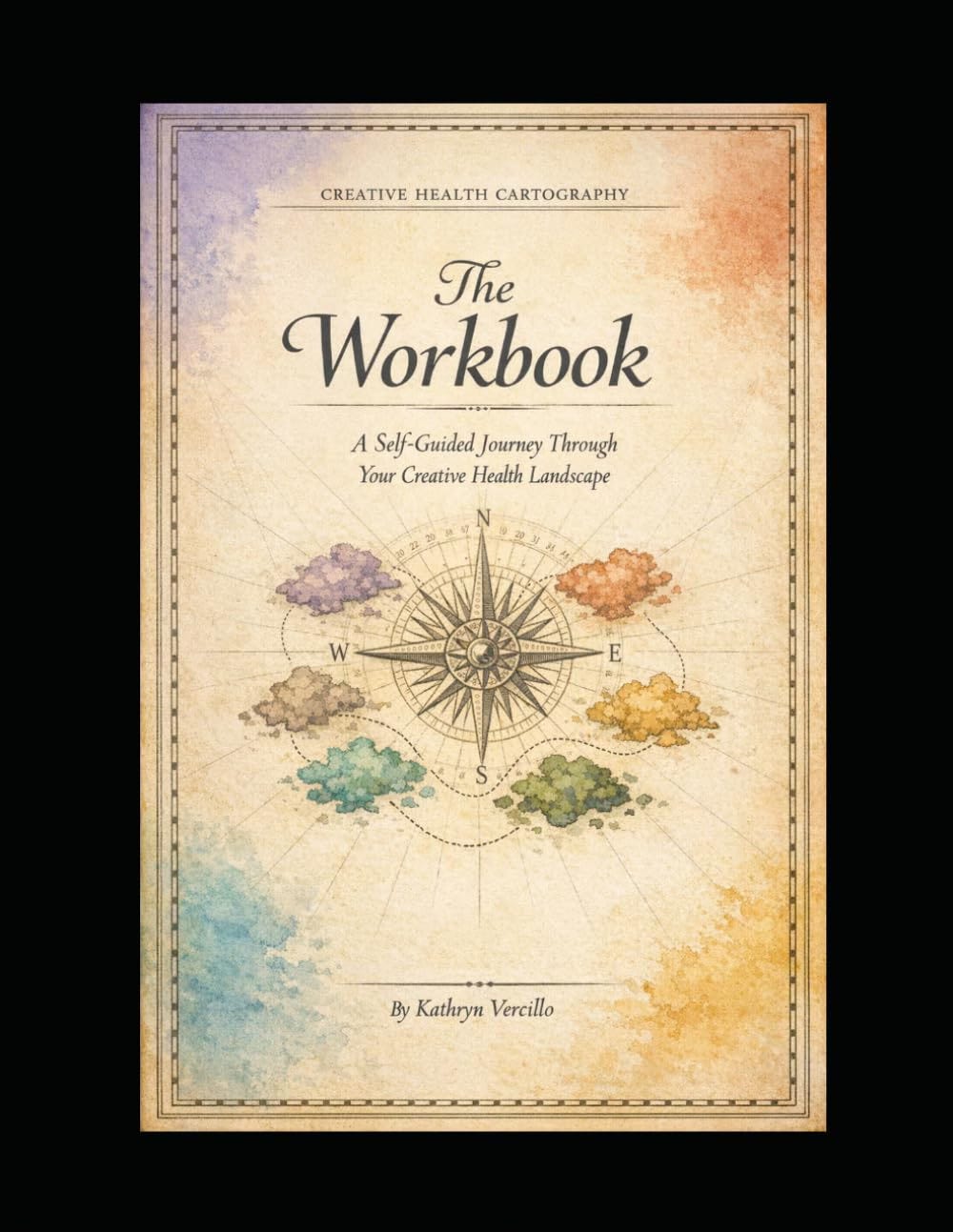
Would you rather explore this on your own? My Creative Health Cartography Workbook is a great place to start.
Writing from others:
With gratitude for the words you share Deleyna Marr, Bruce Lanphear, Dr Alisdair Wiseman, Eunji KD and The Bureau of Queer Art


You never cease to amaze, Kathryn. This is a wonderful, insightful, passionate piece. I was moved to tears by its conclusion. You have opened a door to a world I never realised existed. Your piece had a very personal association for me. My extraordinary wife, Les, used to paint on silk but had to stop because the chronic pain she has lived with for over 35 years meant she could no longer deal with the processes that sit alongside the painting. Then COVID came along and she began to experiment with some acrylics that she had stored away at the back of a cupboard some years earlier. Coming to terms with the new medium was a slow burn, but she persevered and is now producing some of the best work of her life. As you say, I'm not sure she saw it as a win initially. And I suspect she would have made the transition more smoothly had she had access to your wise words beforehand. Nonetheless, she made it. She's a strong woman! Thank you, as always, for challenging my perspectives on life and creativity.
"So good. The split between adaptation as consolation and adaptation as creative intelligence is a sharp one. The constraint does the forcing and the presence does the registering is a line I will keep."