
Wise Words: Quotes From Writers on Life and Creativity
On bodies and mediums, storytelling and self-reflection, creative identity shifts and more ...


On Wednesdays, I share articles related to various aspects of the creative health landscape and at the end of those articles, I share links to other articles you might like.
Why? Because other people’s words can provide a different perspective on a similar topic or a similar perspective in a different way.
And because I like to do what I can to share the work of others to help move it through the world towards the people who are meant to come across it. Especially when it’s an older piece from someone that I can perhaps bring new eyes to.
Here are the links I shared in April’s articles with a quote from each one … do go read the ones that inspire you!
On Bodies and Mediums
In relation to my article:

I loved these quotes from:
“Do we paint and write our pain as artists? Do we dance our pain? Do we act our pain? Do we role play and perform and sing our pain? I believe we do. I believe this is the gift of creativity. It is an outlet for us to find our voice in the suffering. It can bring us into the depths of that sorrow and then carry us forward. Creative expression is an adaptive tool at our disposal. It is an extension of self-compassion.”

“The opposition of pain and power is fascinating. To me, there are obvious implications for disabled and chronically ill people. What does it mean if our pain is unable to be accessed, if the increase of our pain leads to a similar reduction in power? If we can find a way to objectify pain through language, to lift it out of the realm of inexpressibility, will it help? Is it possible to do so?
I think it’s worth trying.”

Fabio Pariante and MuseumWeek in an interview with artist Michelle Alexander who says:
“Texture and gesture are how I communicate what I cannot say in words. I often work from an internal tension, something that feels unresolved, and gesture allows me to process that physically. Texture always starts with the skin. It is the surface I am most drawn to when trying to make sense of things.
It is the texture that holds us tethered and tears us apart. Whether I am melting, stapling, or sewing, I am using touch to move through memory, discomfort, and longing. Texture gives form to what I am feeling when I do not know how else to let it out.”

On Creative Constraints and Conditions
In relation to my article:

I loved these quotes by:
From Ocean Kiani:
“I like to imagine a gardener tending a plot of land. They’re mindful about which seeds to plant and where—factoring in sunlight, soil quality, and the plants nearby. They water, prune dead leaves, and stay aware of the garden’s natural rhythms. Crucially, they don’t force each seedling to grow on a specific timeline; they simply do what’s needed to support life and then let nature do the rest.
In our creative lives, “cultivating the conditions” works similarly. We choose where to place our energy, set up habits or rituals that invite creativity, and—just like a gardener—remain open to change and surprises along the way. We’re less concerned with forcing a particular outcome by a certain date and more focused on creating an environment where ideas can thrive organically.”

From Bryant Del Toro:
“Research on category learning treats categorization as one of the brain’s core cognitive tasks. We are constantly sorting the world into meaningful groupings so that it becomes easier to understand and navigate. Categories help compress complexity. They allow us to generalize and retrieve without having to reevaluate every object from scratch. Ashby and Maddox argue that category learning is such a central problem in cognitive neuroscience precisely because categorization is fundamental to intelligent behavior.”

From Stacy Vajta:
“My “project guilt” isn’t really about project size. It’s about that deeper thing—the sense that if you’re not offering something of seeming significance, something that justifies the time, then what exactly are you doing?
The voice that asks that question is not interested in your nervous system. It’s not moved by the fact that the world is currently on fire. It just keeps asking whether you’re doing enough.
And the strange, almost absurd part is that you can be doing the exact thing that’s keeping you functional—making something small, moving slowly, staying with simple, repetitive work—and still feel like you’re falling short, even when you can feel it working.”

From Momentum Mindset ADHD Coach:
“Every signal that got overridden. Every moment of genuine need that got translated into something more palatable. Your body knows what safety feels like and what it doesn’t. It knows your window of tolerance and when you’ve blown past it. It’s been trying to communicate with you your whole life.
The work is learning how to hear it.”

From Darius Bashar and Chris Assaad:
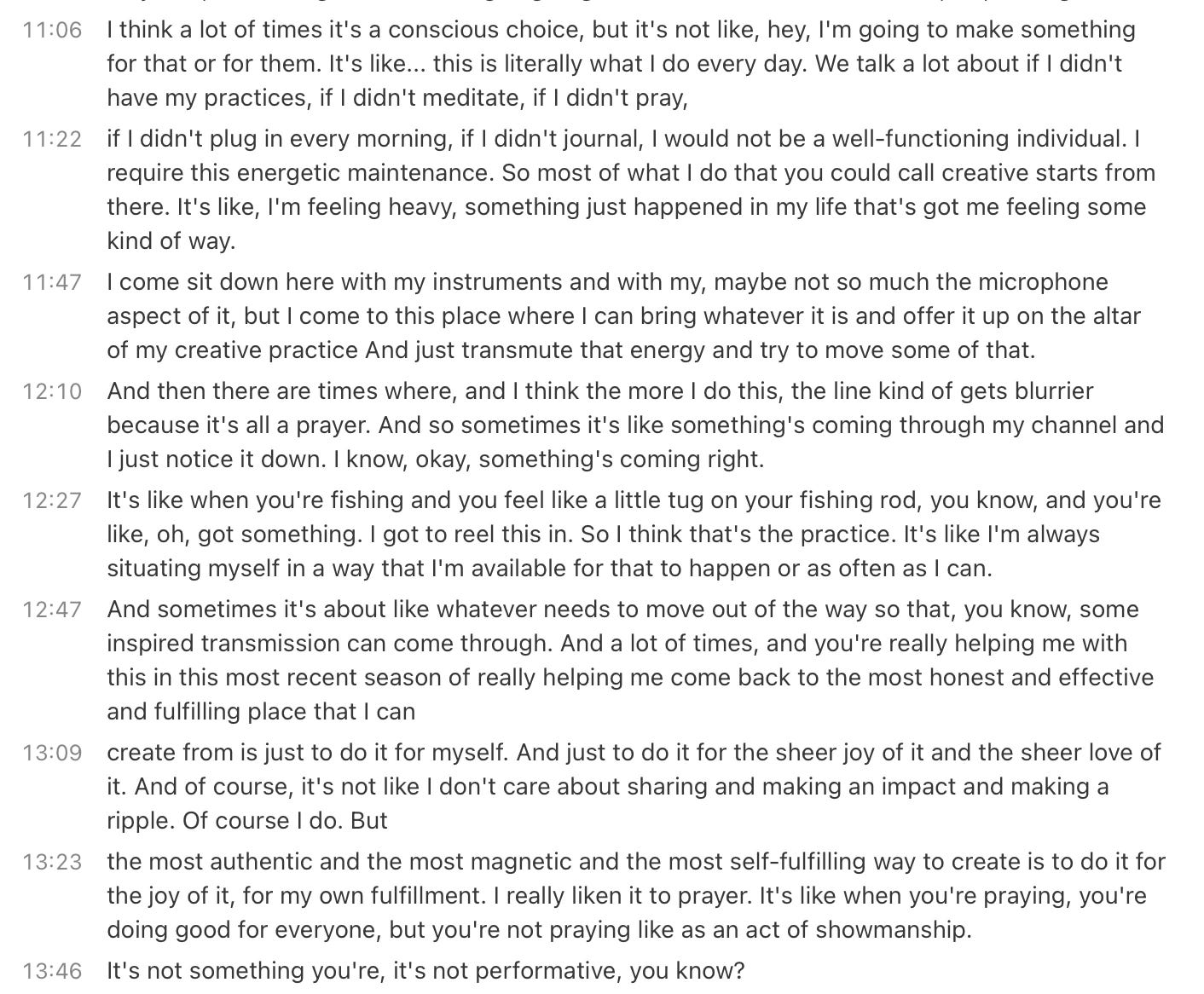

On Storytelling and Self-Reflection
In relation to my article:

I loved these quotes by:
“When someone calls another person a natural storyteller, they're usually responding to a something I like to call a finished product. Like a polished performance, a killer anecdote, a novel that made them cry on the bus. What they don't see is the 10,000 hours underneath it, the drafts, the absolute wack stories, the years of reading, watching, absorbing, and practicing.”

“Introducing myself as an art teacher was never just a statement of profession—it reflected a deep part of my identity. It represented how I saw myself and how others perceived me. The role shaped my daily life, gave me purpose, and anchored my sense of belonging. As I moved into retirement, letting go of this role meant not only stepping away from external markers of status, but also facing the challenge of redefining my sense of self without them.”

“I am, at my truest, a mix of Alchemist and Pattern Namer but I dip in and out of the Explainer, too. I work in long, obsessive, uncombed bursts. I write things and don’t publish them for weeks. I disappear for stretches and come back with something I’ve been quietly turning over and it’s always, always better for the silence. I have tried, with real commitment, to become an Inviter. To show up daily. To be the warm visible presence. And I can do it for a while. Then something in me goes very quiet and very stubborn and refuses.”

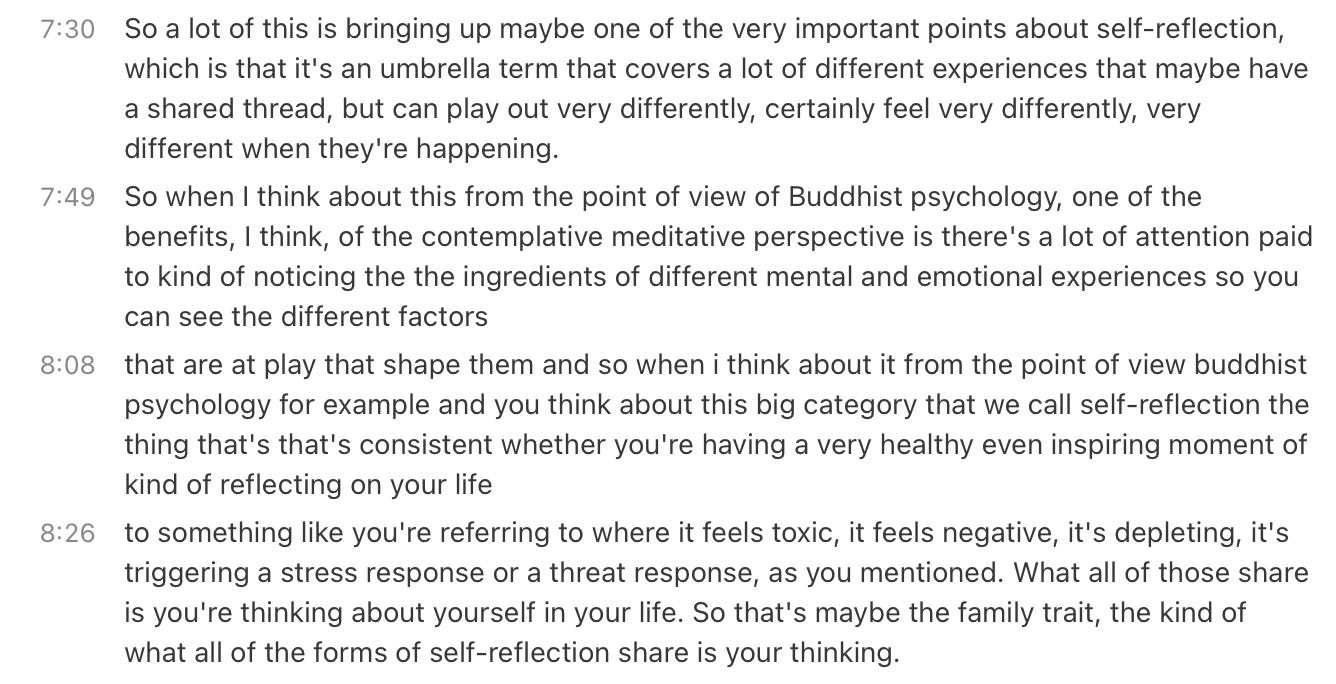
Dharma Lab, Dr. Cortland Dahl and Dr. Richie Davidson:
“Zines, for readers who may not be familiar with this word, are self-published creations that have historically focused on topics that might not have mainstream appeal. These zines, according to another definition are “tools for self-reflection, activism, and creative exploration.”

On Creative Identity
In relation to my article:

I loved these quotes from:
“Sometimes you even sit there wondering if the muse — that holy thing called inspiration — has left you altogether, rather than recognising a simpler truth:
You’re just tired.
Reality has exhausted you.This isn’t about being undercommitted.
It’s about being human”

“I used to downplay everything. I’d create something, and then quietly move on like it didn’t matter. I’d tell myself it wasn’t that deep, or that no one cared. But that belief didn’t just come from nowhere. I was the Black sheep growing up. The one who always felt a little offbeat. That’s why I always say: to move forward, sometimes you have to trace it back.”

“We tell ourselves we should be grateful to still have our talent when we’ve lost so much else. We compare our silence to others who seem to channel grief into masterpieces. We wonder if we’re weak for not being able to “create through the pain.”
But here’s what I’ve learned: creativity requires a certain kind of emotional bandwidth that early grief simply doesn’t allow. When every ounce of energy goes toward surviving each day, there’s nothing left for the vulnerable act of creation.”

“In the wake of one of the most difficult years of my life, I have spent a lot of time feeling like a failure creatively. Words were escaping me, providing not a lick of the catharsis and freedom I have found on the page most of my life. I was coming up against the limits of language and my approach to it.”

thank you so much for including me in this post <3
Love this, Kathryn. Thank you for the shout out. 🙏🏽