
Art history is filled with creators whose mental health experiences profoundly shaped both their artistic output and their place in cultural memory. These explorations move beyond romanticized notions of the "tortured artist" to examine the real, complex relationships between psychological experiences and creative expression throughout history.
Rather than perpetuating myths about madness and genius, these pieces offer nuanced analysis of how specific artists navigated mental health challenges, how treatment (or lack thereof) affected their work, and what their experiences can teach us about the intersection of creativity and psychology today.
This collection honors historical artists' full humanity while drawing insights relevant to contemporary creators.
I have developed these resources after decades of lived experience, interview-based insights, and deep research into the complex relationship between art and health. They are based on my unique 6-part framework.
If you are interested in assistance in applying these ideas to your own life:
INDIVIDUAL ARTIST STUDIES
In-depth examinations of specific artists and their mental health experiences
These studies explore how mental health shaped the lives and work of artists across history, examining the complex relationships between psychological experience and creative expression within their cultural contexts.
I first wrote about some of these artists for my book The Artist's Mind: The Creative Lives and Mental Health of Famous Artists
Renaissance & Early History
When "melancholia" was the language for understanding mental distress
Melancholia: Albrecht Dürer - Historical Mental Health Concepts
History of melancholia diagnosis, how it relates to modern depression, distinction between melancholia and melancholic art, with focus on Dürer's famous Melancholia piece.
Michelangelo Buonarroti: Art and Mental Health History - Historical Perspective
Analysis of how mental health challenges influenced one of history's most celebrated artists, examining letters indicating he worked on Sistine Chapel in state of exhaustion and depression.
19th Century Pioneers
As psychological understanding began to emerge
Excerpt from The Artist's Mind: Richard Dadd - Psychiatric Prison Art
Examination of artist who murdered his father during psychosis and created art while living in psychiatric prison.
Early-Mid 20th Century
Modern psychology emerges alongside artistic innovation
Art and Mental Health History: Sonja Sekula - Abstract Expressionist Outsider
Exploration of an artist who was open about being lesbian, regularly hospitalized for mental health challenges, and worked on small scale when other Abstract Expressionists worked large - examining how her differences limited her fame.
Claude Cahun: The Revolutionary Artist Who Shattered Gender and Identity Through Photography – Surrealism & Trauma
Examines how Cahun’s art emerged from early attachment trauma, family mental illness, anti-Semitic persecution, and gender nonconformity. Explores how their collaborative self-portraits with Marcel Moore functioned as both creative innovation and psychological survival, transforming isolation into a radical visual language of multiplicity, resistance, and healing
Leonora Carrington Art and Mental Health - Surrealism & Psychology
Examination of how mental health experiences influenced one of surrealism's most important female artists, exploring intersection of psychological exploration and artistic movement.
Hilma af Klint: Charting the Unseen Through Art, Spirituality, and the Psyche – Mysticism & Healing
Examines how af Klint’s visionary works bridged art, science, and spirituality. Explores how her engagement with mysticism reflected an attempt to navigate psychic strain, grief, and the need to map the unseen mind.
Georgia O'Keeffe: Where Art History Meets Mental Health - Five Essay Collection
Multi-part exploration of different aspects of O'Keeffe's creative journey and how they were shaped by both mental health and relationships.
Art History and Mental Health: Surrealist Kay Sage - Desolation & Depression
Analysis of whether the desolation, prison-like scaffolding, and muted colors of Sage's dreamscapes reflect history of depression, including her final years and ultimate suicide.
Art and Mental Health History: Carlo Zinelli - Outsider Art Analysis
Exploration of the complex, problematic term "outsider art" through examination of Carlo Zinelli's relationship between art and mental health.
Pain, Parties, Work … Sylvia Plath's Bell Jar Summer - Creative Mental Health Integration
Analysis of Plath's summer of 1953, unveiling deep interplay between mental health and creative expression, including fashion as identity outlet and subtle shifts in handwriting reflecting mental state.
Post-War & Contemporary Era
Modern mental health awareness meets evolving artistic expression
DIANE ARBUS: Where Art Meets Mental Health - Five Essay Collection
Comprehensive exploration of Arbus' complicated family dynamics, history of depression, multilayered sexuality, and other factors that shaped the photographer's creativity.
Isa Genzken: A Half Century of Prolific, Innovative Art and Openness on Bipolar Symptoms - Contemporary German Artist
Analysis of intense artistry marked by periods of institutionalization and alcoholism, examining complex relationship between work and mental health over 50+ years.
Arthur Bispo do Rosario: An Unfinished Chapter - Brazilian Visionary
Study of artist who spent five decades in Rio de Janeiro asylums after psychotic episode, believing his mission was to recreate universe for God, becoming prolific artist while institutionalized.
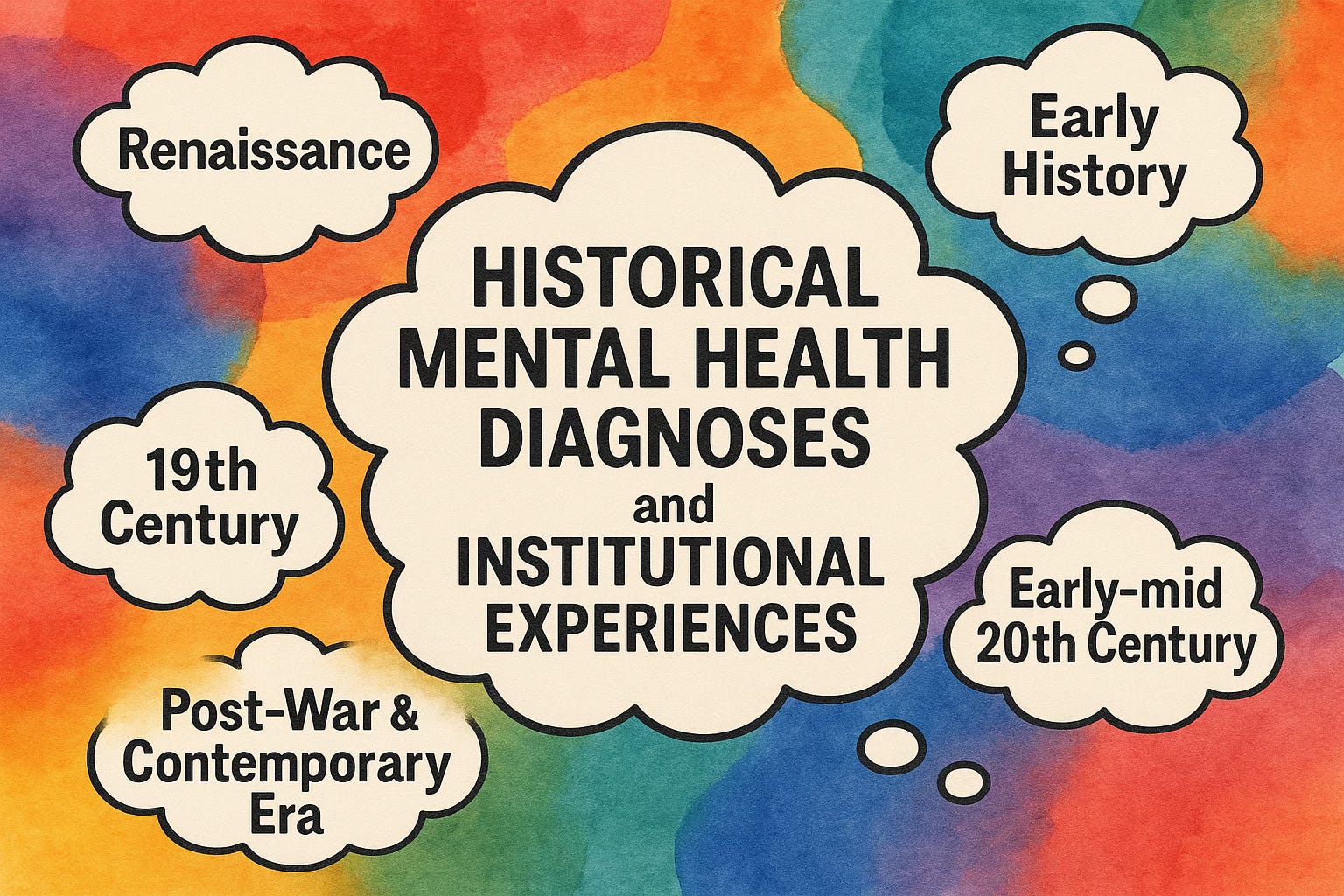
HISTORICAL MENTAL HEALTH DIAGNOSES and INSTITUTIONAL EXPERIENCES
How outdated psychological concepts affected artists
The Impact of Hysteria Diagnosis on Women in Art History - Pathologizing Creativity | Analysis of how Camille Claudel, Dora Maar, Emily Dickinson and others were affected by outdated diagnosis that pathologized women's emotional depth and creativity as mental illness.
Art History and Outdated Mental Health Diagnosis: Neurasthenia - The Rest Cure | Examination of condition similar to depression, focusing on gendered treatments where men were encouraged to adventure while women were prescribed complete bed rest, affecting artists like Alice Neel.
From Neurasthenia to Shadowbanning - Historical Patterns Continue | Analysis of how shadowbanning of contemporary artists parallels historical practices of erasure and infantilization seen in 19th-century treatments.
Asylum Art: Artists Who Created While Living in Psychiatric Institutions (And Those Who Did Not) - Institutional Creativity | Comprehensive examination of Aloise Corbaz, Barbara Suckfull, Bryan Charnley, Camille Claudel, Louis Wain, Martin Ramirez, Unica Zurn and others, exploring what made creativity flourish for some in institutions while being stifled for others.
THEMATIC ANALYSES
Cross-artist explorations of specific topics
Where does the "truth" lie in a self portrait? What history's artists reveal - Self-Portrait Psychology | Analysis of how self-portraits act as windows into artists' self-perception during emotional struggle or stability, examining works by Gauguin, Kirchner, Frida Kahlo and others.
9 Mental Health Lessons from Famous Artists - Historical Wisdom | Exploration of mental health lessons from artists who faced personal and societal challenges, including Gustave Doré's depression within 19th-century context and creative resilience of Joan Miró and Alice Neel.
WHY THIS HISTORICAL PERSPECTIVE MATTERS
Understanding how mental health and creativity have intersected throughout history helps contemporary artists:
Recognize patterns that transcend individual experience
Understand treatment evolution and how it affects creativity
See their struggles in context rather than isolation
Learn from both successes and failures in balancing mental health and artistic practice
Challenge myths about creativity requiring suffering
These historical perspectives also illuminate how cultural attitudes toward mental health have changed and how they continue to shape artistic communities today.
Art history is not just about the past. It's about understanding patterns of human creativity and psychological experience that continue to shape how we create today.
Want to explore how these historical insights apply to your creative practice? Order a Creative Health Assessment or Book a 1:1 Coaching Call.
Looking for contemporary perspectives? Visit Creative Psychology Essays
Want to know about my own experiences? Visit Personal Essays