

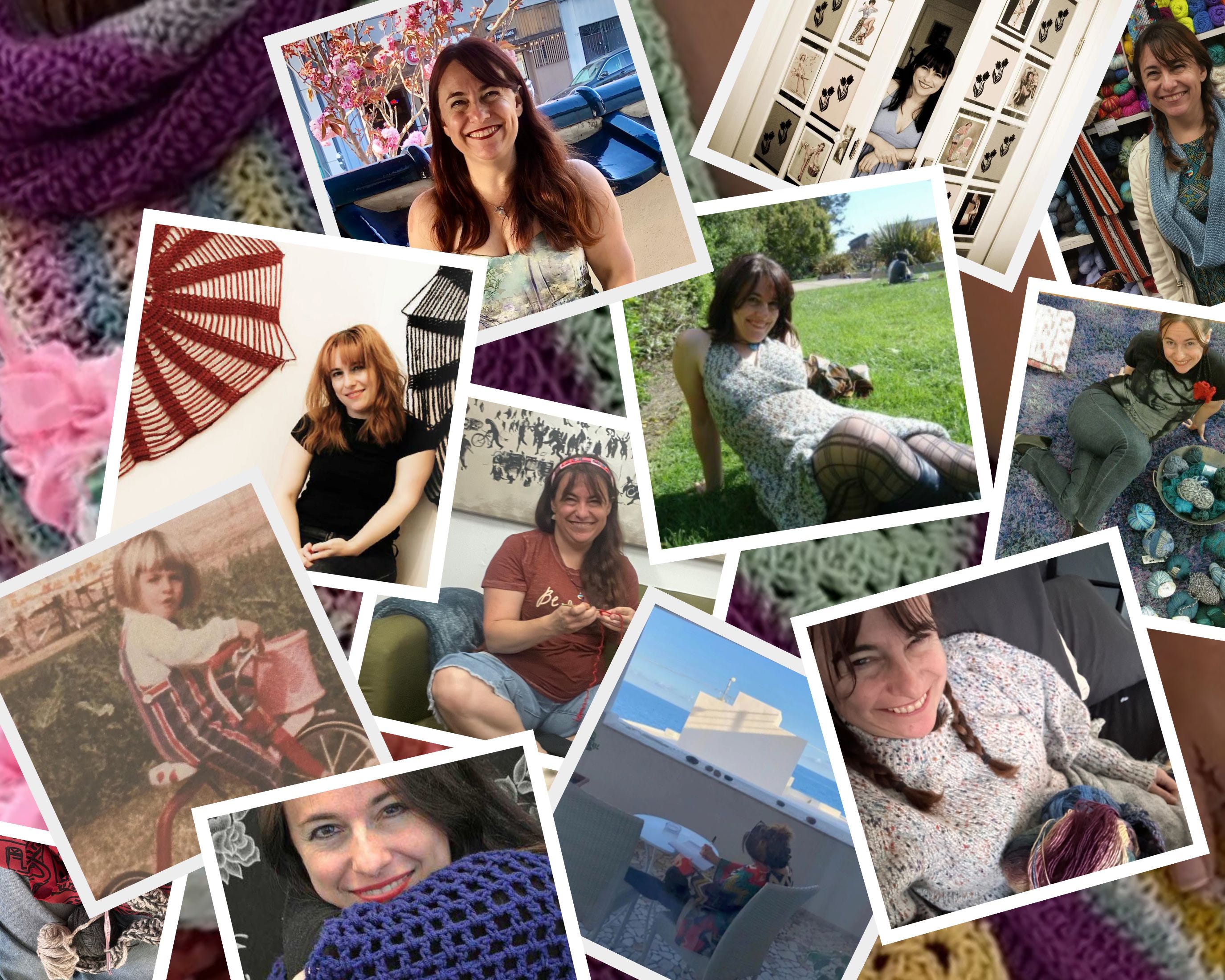
Welcome to Episode 7 of the Create Me Free podcast. I decided to circle back to the beginning and share a bit of my story with you including how I ended up where I am today in terms of the work I do exploring how health and circumstance impact creativity.
I cover a lot of ground: my family, my teenage years, law school, crochet, a woman named Marinke whose death changed the direction of my research. Here’s a little bit of what’s in the podcast:
How creativity and mental health became my work
I was in my late twenties when I crashed. Undiagnosed depression, years of burning through jobs, a semester of law school in San Francisco that clarified only that I was in the wrong place. By the time I found a good therapist and a psychiatrist and started medication that actually helped, I had almost no capacity left for anything that required effort.
That is when I picked up a crochet hook.
Crochet helped because it interrupted rumination. Ruminating, turning the same thoughts over and over without resolution, was the central feature of my depression that made everything else worse. Crochet gave my mind just enough to focus on that the loop broke. The repetitive bilateral motion also did something to my nervous system that I didn’t have language for at the time. I came to research the science of it later: relaxation response, embodied attention, what happens when scattered awareness gets pulled into the hands.
I started writing about it. People wrote back. I became curious not just about whether crochet helped but about why, and when, and what happened when it stopped helping. That curiosity was the start of two decades of research at the intersection of creativity and mental health.
When the tool stops working
Three books into the crochet-and-healing territory, I started asking harder questions. Crochet was no longer always working for me. In certain depressive periods it was inert. I’d pick up the hook and feel nothing, or feel the absence of feeling. I became interested in what that meant.
Why does a creative practice help sometimes and fail at others? What actually happens in the relationship between a health challenge and a specific medium? Is it always therapeutic, or can it sometimes be neutral, or harmful? Was crochet a special case, or was this pattern visible across all creative forms?
Those questions took me to graduate school twice and into years of interviews with artists about their actual experience. What I found, documented across hundreds of conversations, is that health and circumstance affect creativity across six recognizable areas: creative process, creative medium, content, productivity, identity, and business and sustainability. That became the Creative Health Cartography framework. The framework became the workbook, the podcast, and the mapping process I offer now.
What the map reveals
The mapping metaphor comes from something in how I think. My brain is non-linear, perhaps neurodivergent, certainly not neurotypical, altered by years of severe depression in ways that are now simply how I process the world. I see patterns before I see sequence. Looking back at my own life I can construct a coherent arc. Living forward, I navigate by terrain rather than by timeline.
When I work with someone on mapping their creative health landscape, I look for the terrain between where they are and where they want to be. Mountains, canyons, rivers. The things that appear as obstacles often turn out to be features of how a person’s health and creativity interact, worth understanding rather than simply removing.
The places where creativity and mental health intersect are rarely simple. Depression can make a lifelong medium feel inaccessible and also push someone toward an entirely different practice that sustains them through the hardest periods. Physical illness can close down one scale of work and open another. Financial precarity shapes creative identity in ways that look like artistic failure from the outside and are, on closer examination, something more complex and more interesting than that.
This is the work I came to through my own version of all of it. Through living it and becoming curious, rather than through planning to study it. Listen to the podcast to hear more about all of this.
Some podcast episodes like this one, are free, but most require a subscription. Why? Because this work takes work. Subscribers also get lots of other perks.


