

Process is how you create. Medium is what you use to create.
That sounds simple but it gets more interesting when the dimension of health is in the picture.
In my work over more than two decades at the intersection of creativity and health, I’ve seen medium treated as a fixed thing. You’re a painter, a musician, a writer. The medium is the medium. What the Creative Health Cartography framework recognizes is that medium is actually a relationship, and like any relationship, health changes it.
That’s what we begin to talk about in today’s introduction to the next several episodes of the Create Me Free podcast.
What medium means in this framework
Medium here is the full physical, sensory, cognitive, emotional, and financial relationship with how you make.
The physical dimension is the most straightforward: what your body has to be able to do. The posture required, whether you stand or sit or lie down, the fine motor precision, the grip strength, the stamina, the breath. Some of us have bodies that do these things without thinking. Some of us have bodies that do them differently, or on some days and not others.
The sensory dimension includes what the work sounds, smells, and feels like while it’s happening. What light the medium needs. What temperature. What level of stimulation the making requires. Health conditions, and especially nervous system conditions, shape what the sensory environment of the studio can hold.
The cognitive dimension is one that often gets overlooked. Some mediums require sustained, complex decision-making across an entire session. Others are organized around repetition and rhythm. Crochet is the one I return to personally. It’s repetitive, it’s rhythmic, you can follow someone else’s pattern or just repeat the same basic stitches, and it does not require high cognitive load. When I have brain fog, I may not be able to work in my medium of writing. I can almost always work in crochet.
The emotional dimension: mediums produce different emotional registers. Some materials generate calm and quiet presence. Others are deeply engaging in ways that surface difficult material. Writing memoir, for example, can bring up things that make the session hard. An abstract mark-making practice working with the same content might not. That’s information about the relationship between you and the medium, not a verdict on either one.
And then there’s the financial and logistical layer, which gets the least airtime. Some mediums are expensive. Some require studio space or equipment. Life-size sculpture and a ball of crochet yarn are operating at completely different scales of financial and spatial access. Health impacts our income, and income impacts what we can access in terms of materials and space. That’s part of the medium relationship too.
The concept of affordances
A concept I keep coming back to in this area comes from psychologist James Gibson: affordances. The affordance of an object is what it makes possible for a particular body. A staircase affords climbing for a person with full mobility. For someone using a wheelchair, the same staircase affords an obstacle. The stairs are the same stairs. The affordance depends entirely on the relationship between the object and the body meeting it.
That’s what happens with creative medium and health. The oil paint is the same oil paint. The canvas is the same canvas. What they afford you changes depending on what your body can do today, which may be different from yesterday, or from five years ago.
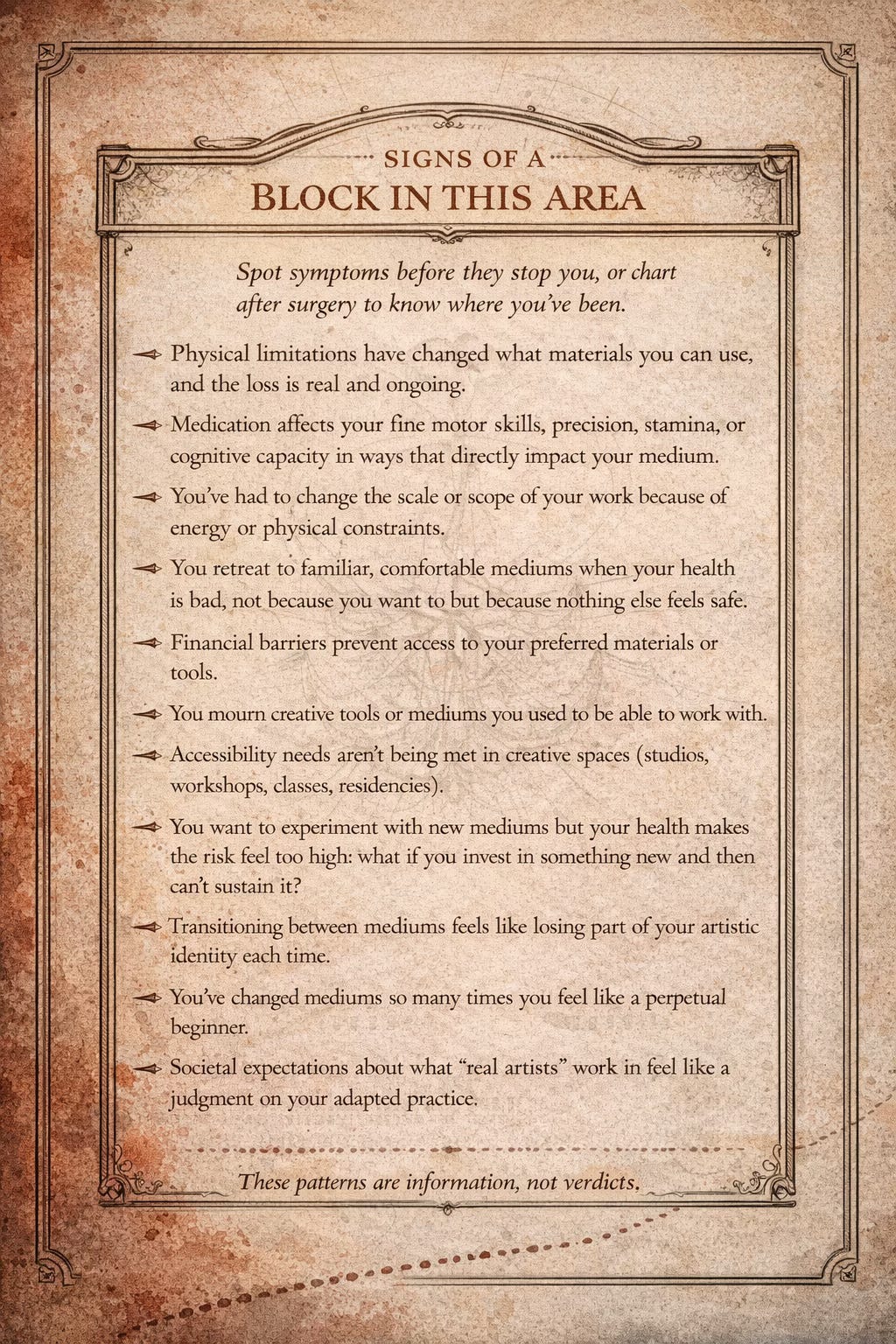
Signs of a block in this area
I’ve named eleven signs of a block in the medium area in the workbook.
A few:
Physical limitations have changed what materials you can use, and the loss is real and ongoing.
You retreat to familiar, comfortable mediums when your health is difficult, and it doesn’t feel like a choice.
You keep shifting from medium to medium and feel like you’re always beginning.
Your accessibility needs aren’t being met in the creative spaces you’re working in.
That last one reminds us that this is a structural issue as much as it is a personal one.
What the body knows
One of the adaptations I see again and again is something one person I’ve worked with described as his body choosing the medium rather than him deciding on his medium consciously.
During his most difficult health periods, certain materials appear in his hand, a particular weight of paper, a specific pencil, a soft fiber, before he’s made any conscious decision. He’s learned to pay attention to that. He’s learned there’s information in it. He’s learned to trust it rather than override it.
The medium your body reaches for is telling you something. Learning to read it, rather than override it, is one of the most consistent paths toward a creative practice that actually sustains you.
What’s coming in this series
This is the first of four episodes on the area of medium. Next week (Episode 9), I’ll go into my own medium biography: the mediums I’ve worked in, what changed, what was hard, what was a gift. Episode 10 will look at artists across history whose health conditions restructured how they worked with materials, and the different mechanisms through which that happened. Episode 11 goes into the theoretical underpinning: the nervous system intelligence in materials and the body knowledge that lives in making. Episode 12 works through exercises and reflection.
Paid subscribers have access to all four.
Interested in working with how health and circumstance are impacting your own creative medium? I would love to work with you!


