
Dear Artist Whose Work Feels Too Personal to Share ...
You're never quite as naked as you fear ... but you also don't owe the world every piece of yourself

Dear artist whose work feels too personal to share,
Dear singer-songwriter with songs about real people in your life,
Dear photographer with portraits that reveal too much,
Dear collage artist whose pieces hold things you’ve never said out loud,
Dear poet with verses locked in a folder on your desktop,
Dear fiber artist with work that carries grief you haven’t named,
Dear creative who makes the raw thing and then hides it,
Dear maker whose most meaningful work feels too exposing to release,
Dear soul who creates from the deepest places and then protects what emerges,
This is for you.
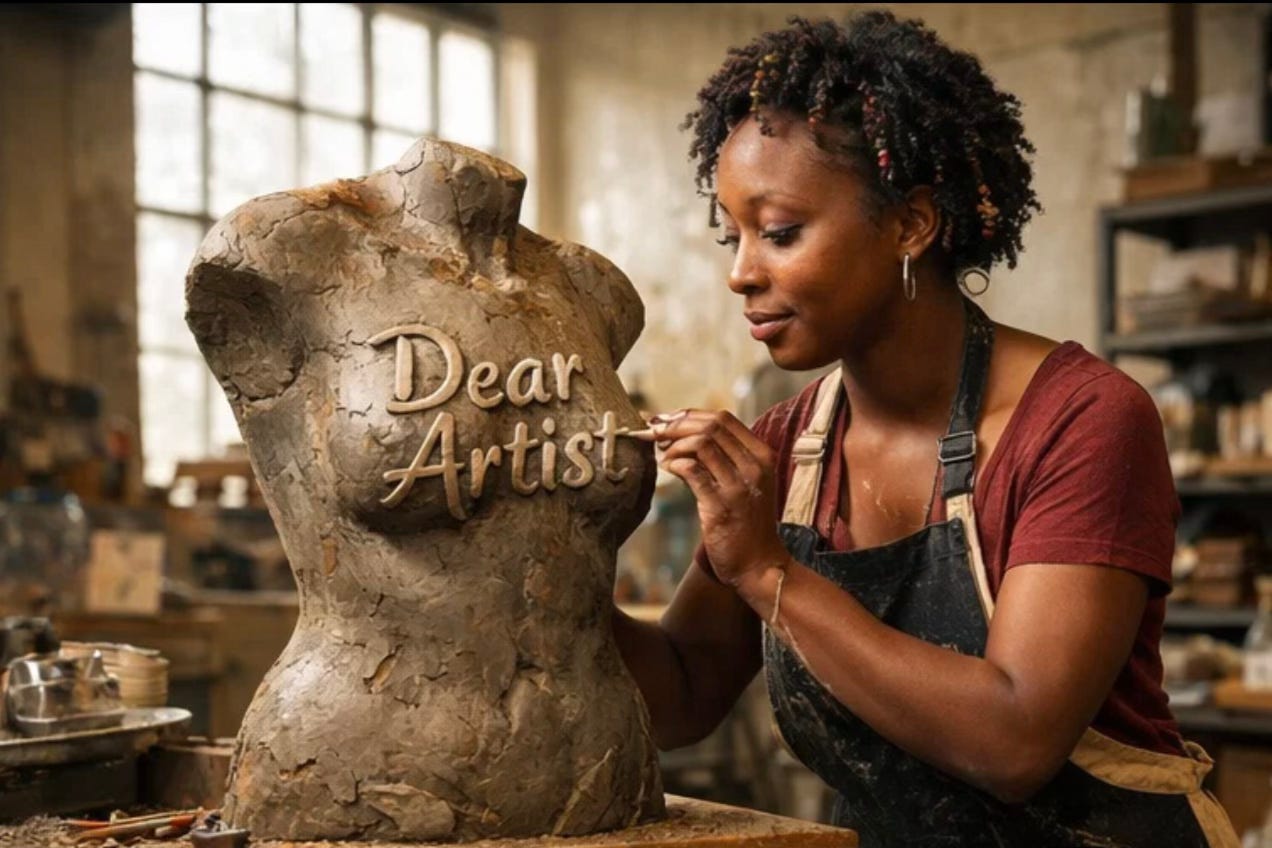
The work that feels too personal to share is often the work that matters most. It comes from somewhere real. It carries your actual voice, your actual experience, your actual vulnerability. And precisely because it’s real, the thought of putting it into the world feels terrifying.
You’re not wrong to feel protective. What you’ve made contains something of yourself. If you share it, people will see that something. They might misunderstand it. They might judge it. They might see you in ways you’re not sure you want to be seen.
This is the particular bargain of making authentic art: the more honestly you create, the more exposed you become.
But here’s what I want to offer: you don’t have to share everything. And the sharing doesn’t have to be all at once.
Some artists keep certain work private for their entire lives. They make it because they need to make it, and they keep it because it serves them better that way. The work is complete even if no audience ever sees it. Creating for yourself alone is valid. It’s not a lesser form of art. It’s simply a different relationship between maker and made.
If some of your work is meant to stay private, let it stay private. You don’t owe the world every piece of yourself.
But if part of you wants to share, if you feel the pull toward putting the work out there even as you feel the fear, then let’s talk about that.
The fear of exposure often contains within it a fear of being truly known. If people see this, they’ll know something about you that you haven’t told them in words. They’ll know about your grief, your desire, your struggle, your shame. They’ll see past the surface and into something you’ve kept hidden.
And they might. That’s real.
What’s also real is that being truly known, while terrifying, is also one of the deepest things humans seek. We hide ourselves to stay safe, and we also long to be seen for who we actually are. Art can be a bridge between those two impulses. It can offer a way to be seen without having to speak directly, to reveal without having to explain, to be known while retaining some protective distance.
The work is not you, even when it comes from you. People who see the work will interpret it through their own lenses. They’ll project their own meanings onto it. They’ll understand what they understand, and miss what they miss, and often what they see will be as much about them as it is about you. This is sometimes frustrating, but it’s also protective. You’re never quite as naked as you fear.
What if you started with a small share?
Not the most vulnerable thing you’ve ever made. Something one step closer to personal than what you usually share. Something that feels slightly risky but not catastrophic. Test the waters. See what happens. Let the experience of surviving that smaller exposure build your capacity for larger ones.
What if you shared anonymously?
Some artists find freedom in separating their personal identity from their work. The work goes into the world, but it’s not attached to their name. They get to see how people respond without feeling like they, personally, are on display. This can be a stepping stone toward more visible sharing, or it can be a permanent arrangement that works.
What if you considered who you’re sharing with?
The vulnerability of sharing isn’t uniform. Showing your personal work to a trusted friend is different from posting it publicly. Sharing within a supportive community is different from exposing it to strangers. You can choose your audience. You can start with the safest people and expand from there only if you want to.
What if the risk is worth it?
Not always. Not for everyone. But sometimes, sharing the personal work leads to connection you couldn’t have found any other way. Someone sees what you made and recognizes something in themselves. They feel less alone because you showed them something real. The vulnerability creates a bridge that safer work wouldn’t have built. That connection is the reason some artists continue to share despite the fear.
You’re not obligated to share. But if you want to and the fear is what’s stopping you, here’s what I know: you will probably survive. The exposure will be uncomfortable, and you will probably survive it. The fear promises catastrophe, but most of the time, what happens is smaller than the fear suggested. People respond. Some get it, some don’t. You feel tender for a while. And then you keep going.
The work that feels too personal might also be the work that’s most needed. Not everyone will want it. But the ones who do might be the ones you most want to reach.
Whatever you decide, the work is still valid, still art, still yours. Shared or kept. Visible or private. It matters because you made it.
With respect for your boundaries and your courage,
Kathryn
Read More:
I Didn’t Mean to Tell You That: Accidental Honesty in Creative Work

I didn’t sit down planning to tell you the truth. Not that one. Not then.
What I had in mind was something safer. A more distant metaphor. A topic I’d already made peace with. I had written about vulnerability before and thought I had learned how to steer it, how to shape it into something contained. But then there it was again. A sentence I didn’t mean to write. A line that held more weight than I expected. A piece of my story I didn’t even know I was offering until it was already on the page.
And sometimes I let it stay. Not always. But sometimes.
The Myth of the Lone Genius: Relational Creativity and Why We Need Each Other

The idea of the lone genius persists as one of the most enduring myths in creative culture. We envision the artist tucked away in a garret, the novelist writing in solitude, the visionary making breakthroughs in isolation. This narrative feels romantic and it is culturally reinforced, but it is rarely true. More importantly, it is often harmful.

Thank you. I have been feeling this tension as a writer and painter … Stepping past the fear and discerning what’s private and what I feel called to share is on going. 🤍
Thank you Katherine for this important post. As a writer, sometimes the work feels so personal and there is then a concern of being judged. I had a professor when working on my M.A. who judged me over something I wrote about my life. Not the work, but me.