
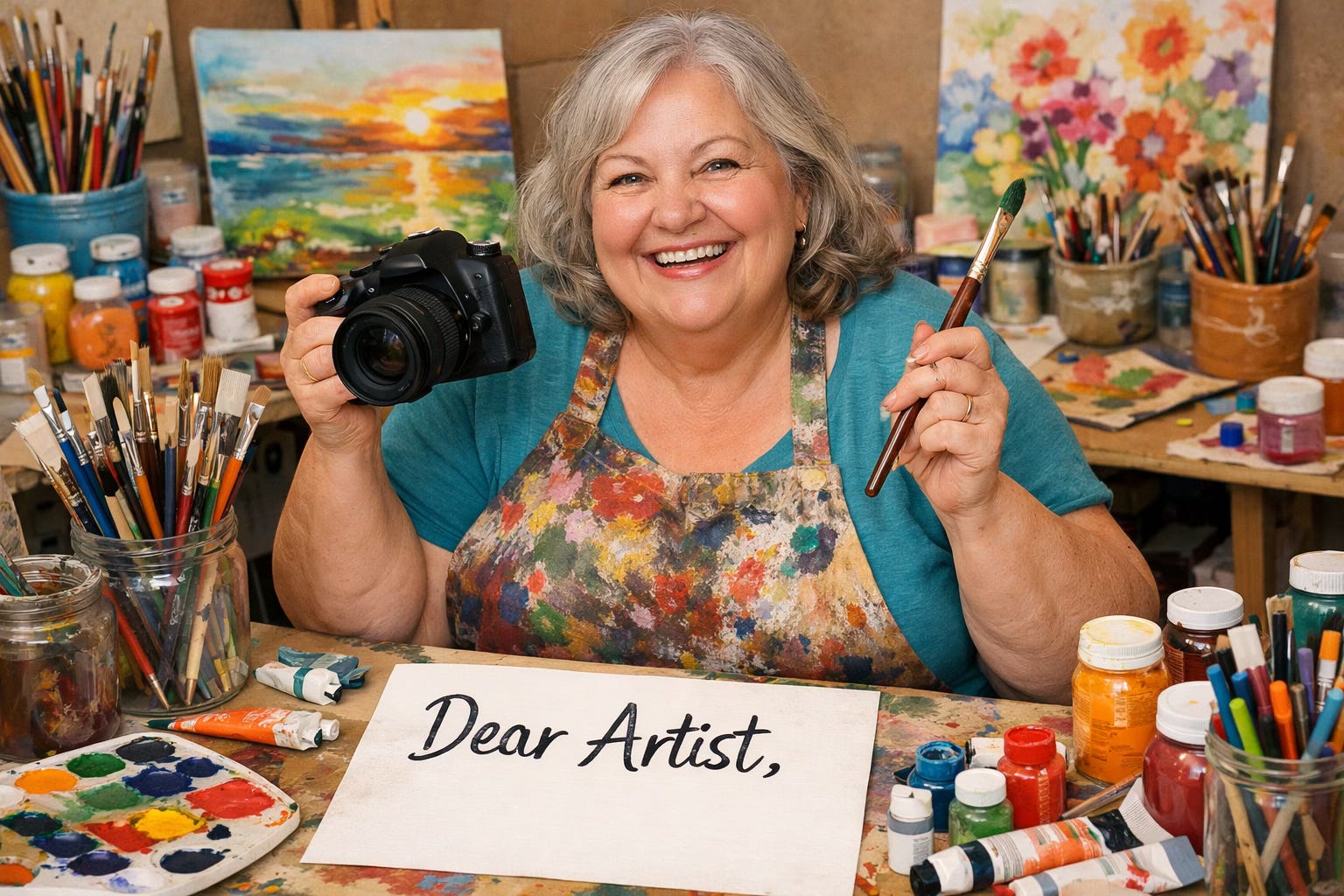
Dear Artist learning to create in a new way ...
The technical skills are what you're rebuilding. The creative core is still intact.

Dear artist picking up unfamiliar tools because the familiar ones no longer work for you,
Dear writer learning to dictate when your hands can no longer type for hours,
Dear painter experimenting with digital brushes because standing at an easel isn’t possible anymore,
Dear maker whose body or circumstances have forced you into creative reinvention,
Dear creative in the awkward, humbling stage of being a beginner again,
Dear soul grieving what used to be while trying to build something new,
This is for you.
Learning something new when you didn’t choose to learn something new is its own particular challenge. It carries the weight of loss alongside the uncertainty of beginning. You’re not starting fresh with beginner’s enthusiasm; you’re starting over with the memory of competence, the ghost of what your creative practice used to be.
That ghost can be heavy company.
You remember what it felt like to know what you were doing. To trust your hands, your process, your relationship with your materials. There was ease there, even when the work was hard. The ease of familiarity, of accumulated skill, of a practice shaped over years to fit exactly who you were.
Now you’re somewhere else. Fumbling with tools that don’t feel natural. Producing work that doesn’t match what you see in your mind. Spending energy on technical challenges that used to be automatic. The gap between your vision and your execution has widened again, and that gap can feel like failure even when it’s actually just learning.
Please hear this: you are not starting from zero.
Everything you learned in your previous creative practice travels with you. Your understanding of composition, of storytelling, of color or rhythm or texture. Your sense of pacing, of when something is working and when it isn’t. Your creative instincts, developed over years, are not lost. They’re looking for new ways to express themselves through unfamiliar channels.
The technical skills are what you’re rebuilding. The creative core is still intact.
This doesn’t mean the learning is easy. It isn’t. Being a beginner again when you remember being skilled is disorienting. Your standards are high from years of developed practice, but your current abilities are low because the tools are new. That mismatch is frustrating. It’s supposed to be frustrating. The frustration is not evidence that you’re failing; it’s evidence that you’re asking a lot of yourself.
What if you could hold both truths at once? You are a skilled artist and you are a beginner at this particular thing. Both are true. The skill doesn’t disappear because you’re learning something new. The learning doesn’t invalidate everything you’ve already accomplished.
Some artists find that the forced reinvention leads them somewhere unexpected. The new medium has possibilities the old one didn’t. The constraints that pushed them into change become doorways into creative territory they wouldn’t have explored otherwise. This isn’t guaranteed, and it’s not meant to minimize the loss. But it’s worth noticing if it starts to happen.
Go slower than you want to. The temptation is to push through the learning curve as quickly as possible, to get back to the competence you remember. But rushing often leads to frustration and discouragement. The learning takes time, and giving yourself that time is an act of kindness, not weakness.
Let the early work be rough. It’s supposed to be. Every artist who ever mastered anything went through a period of making work that didn’t meet their own standards. The difference is that for you, this comes after a period of mastery rather than before. But the stage is the same. You’re building new pathways, and pathways take time to become smooth.
Find small wins. When you’re learning something new, progress can be hard to see. Look for the tiny victories: a technique that clicks, a tool that starts to feel more natural, a piece that works even if it’s simple. These small wins are the building blocks of the larger transformation you’re working toward.
Ask for help. You don’t have to figure out the new medium alone. There are people who know these tools, these techniques, these approaches. Tutorials, classes, communities, mentors. The learning can be lonely, but it doesn’t have to be solitary. Let others help you accelerate the parts that can be accelerated.
Grieve what you’ve lost. The reinvention might be necessary, even ultimately positive, and it can still involve real loss. You can be sad about the practice you’re leaving behind while building the practice you’re moving toward. Both feelings are allowed to exist at the same time.
Your identity as an artist isn’t tied to a single medium or set of tools. You were an artist before you learned the first way. You’re still an artist while you’re learning this new way. The form changes. The core remains.
This is hard. Learning when you didn’t want to learn. Adapting when you didn’t want to adapt. Starting over when you’d rather have continued. But you’re doing it, which means something about who you are as a creative person. You could have stopped. You didn’t. You’re finding a new way because the old way closed, and that takes courage even when it doesn’t feel like courage.
The work you make on the other side of this learning will carry everything you’ve been through. It will be informed by your history and shaped by your transformation. It will be something that only you could make, because only you have walked this particular path.
Keep learning. Keep making. The fluency will come.
With admiration for your willingness to begin again,
Kathryn


Wow, you just put into poetic words what I’ve been struggling with lately. In fact, I just wrote about how I’m scared of challenges because I felt I’ve regressed as an artist. I’m working my way through but this post has just reaffirmed to me that it’s possible and that I may experience a joy from a change in a new skill that I never would have before if my life didn’t drastically change. So no more lamenting. I’ll get frustrated, yes. But I can’t wait to see what’s on the other side. Thankyou.
I love this topic because it sits at the heart of creative identity. I believe deeply that while creative identity is constructed from a myriad of specific experiences, its application is general. Consequently, going into something new and becoming a beginner (again) does not extinguish the fire we lit with previous creative endeavours. We can use the energy from that fire to ignite new passions, knowing that we survived being a beginner before and will do so again in the future. One of the tricks, I think, is not being too harsh with ourselves as we begin. It's unreasonable to apply the standards of developed practice to something new and unfamiliar. (I'm being the hypocrite here, because I do this every time I start something new, and I get what I deserve - unnecessary disappointment. Maybe, one day, I'll take some of my own medicine!)