

If you were to write the biography of your creative medium … its full chronological story from the first time you worked in it through every significant change since …what would the narrative reveal?
In my experience, it would reveal considerably more about your health history than almost any other form of creative self-examination.
The relationship between artists and their mediums tends to track health in ways that are visible in retrospect and mostly invisible in the moment. Medium changes cluster around health events. Retreats to specific materials tend to coincide with periods of difficulty. The scale, duration, and physical demands of the work often shift in direct response to what the body is managing, even when the artist describes the shift in aesthetic terms.
You already have the answers to unblocking your creativity. Find them with the help of a Creative Health Map.
What the Creative Medium History Map Shows
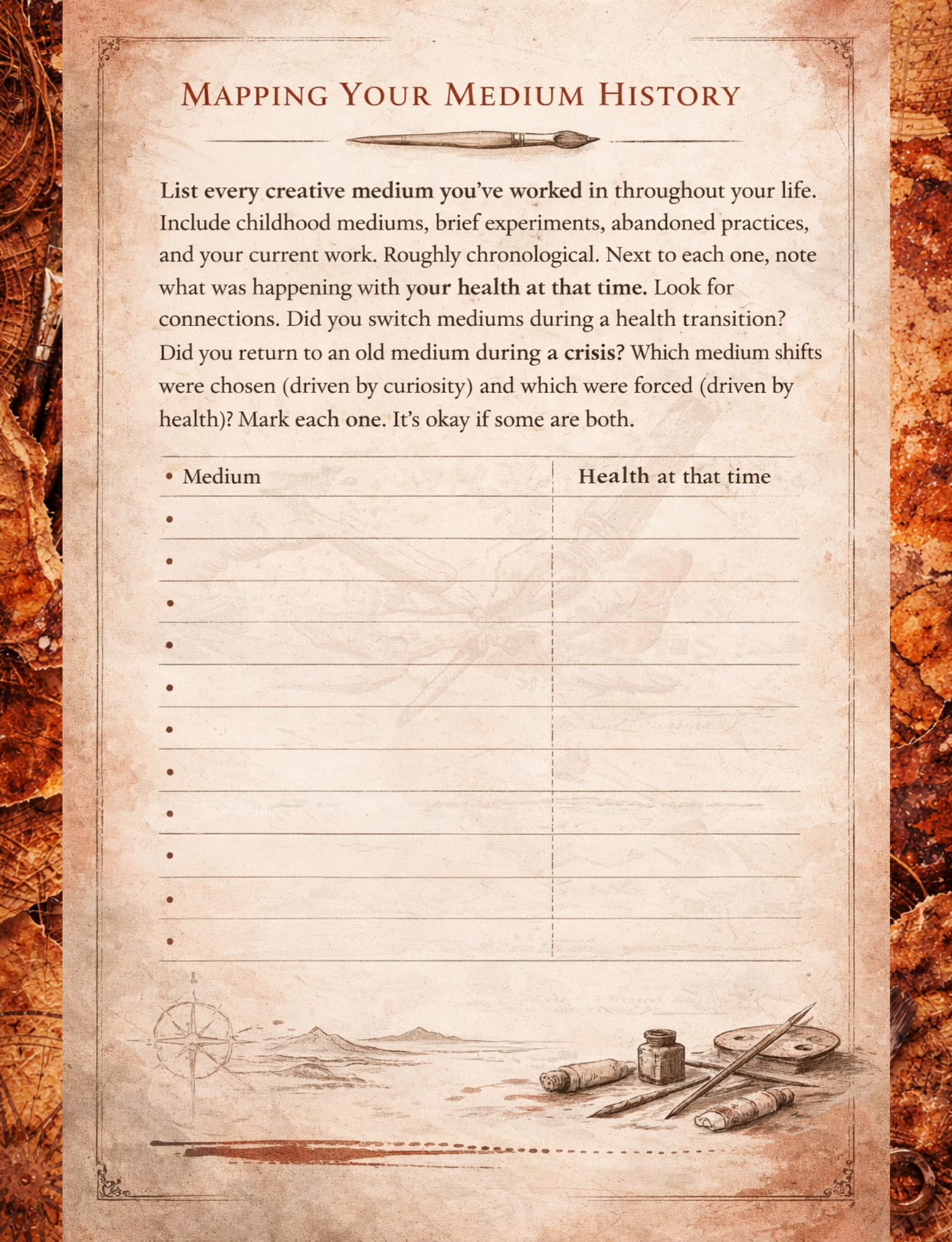
A mapping exercise that lists every medium worked in, roughly chronologically, alongside what was happening with health at each point, consistently reveals connections that the artist had not previously made explicit. A shift to a less physically demanding medium that happened in the same year as a diagnosis. A period of working only at small scale that coincided with a period of significant physical limitation. A return to an earlier or simpler material during a period of particular emotional difficulty.
These connections tend to be obvious in retrospect and genuinely invisible in the moment, because in the moment the medium change was experienced as aesthetic choice or practical necessity rather than as a health response. Naming them as health responses changes what the creative medium history shows: a creative practice that has been more health-responsive than the aesthetic narrative suggested, navigating its own constraints with more intelligence than was consciously directed.

What the Long Relationship Accumulates
Artists who have worked in the same medium for a long time develop a relationship with it that is qualitatively different from a shorter medium relationship. The knowledge becomes partly somatic: housed in the hands and body rather than in describable rules.
Philosopher Maurice Merleau-Ponty described what happens in the expert practitioner’s relationship with their tools as a form of bodily extension: the pianist’s fingers extend into the keys, the blind person’s cane extends into the floor. The tool ceases to be an object operated by the body and becomes an extension of the body-subject, so incorporated that it is experienced as part of the perceiving self rather than as something separate. The musician who says “my instrument knows things I don’t” is describing exactly this: the somatic knowledge of the long relationship has migrated into the extension itself.
When health disrupts the long creative medium relationship, it disrupts this extension. The medium reverts from being part of the body-subject back to being an object operated by the body, and the knowledge that lived in the extension becomes partially inaccessible. The painter can describe how the brush should move. The hands that knew how to move it without describing it have lost some of that knowing. This is the loss that health-driven disruption of a long medium relationship tends to produce, and it is considerably more significant than the loss of a skill.


What Identity Has to Do With Medium History
The long creative medium relationship and the creative identity tend to become deeply intertwined over time. For artists who have worked in the same medium across a significant portion of their lives, the medium shapes perception itself: the painter sees differently than the sculptor, and the difference is real, built through years of attending to the world through a specific medium’s frame.
When health disrupts this long relationship, it often disrupts the identity in parallel. The question “can I still do this” tends to carry inside it the question “who am I if I cannot do this in the way I have done it.” This is why creative medium loss at the level of a long relationship tends to feel like considerably more than a practical inconvenience. It is a loss that operates at the level of self, and it deserves acknowledgment proportionate to that.
Much of the grief around disrupted medium relationships remains invisible to the people nearby, who tend to register only the practical loss: the painter who stopped painting, the writer who stopped writing. What they miss is that the medium had become the instrument through which the artist knew themselves. The mourning is for a way of thinking, a way of ordering the world, a way of being legible to oneself. Without language for this kind of loss, the grief often relocates into other symptoms: depression, creative paralysis, withdrawal from the practice, withdrawal from other artists, long seasons of self-criticism that attach themselves to the question of creative ability when the underlying question is an identity in mourning.
What tends to persist underneath the medium, even when the practical relationship with it changes, is the perception that the medium built. The painter who can no longer paint still sees as a painter sees. The writer who has had to set down the pen still thinks in sentences. This residual perception often registers in the body as something like a ghost limb, an ache with nowhere to go, and the ache gets mistaken for failure. The steadier reading is that the perception has outlasted the medium’s interruption, and is waiting to learn what it can flow into next. That waiting period is part of the practice, even when it looks from the outside like creative silence.

What Evelyn Glennie’s Practice Demonstrates
Percussionist Evelyn Glennie became profoundly deaf at twelve and has maintained one of the most significant careers in contemporary classical and experimental percussion. What makes her practice relevant here is how she describes her relationship with her medium: she experiences percussion through vibration received across the entire body, particularly through her feet, legs, and the surface she is standing on. Her medium relationship is conducted through somatic sensation rather than through hearing, a complete renegotiation of how the medium is received without abandoning the medium itself.
Glennie’s practice demonstrates that the long creative medium relationship can survive a fundamental change in the sensory channel through which it is conducted. What had accumulated over years of practice, the understanding of how rhythm and resonance and timing work, the aesthetic judgment about what a piece of percussion music does, the bodily knowledge of instrument mechanics: these remained available and continued to develop after the hearing became unavailable. The medium relationship reorganized around what the body could offer rather than ending.
This is, of course, not an argument that every creative medium loss can be navigated in this way. Some forms of loss are more permanent and more complete. It is an illustration of what remains when the body’s relationship with a medium has to change significantly: the accumulated understanding, the aesthetic judgment, and the quality of attention the long relationship built tend to have more durability than the specific physical channel through which they were previously expressed.
What the Comfort Medium Carries
The medium that has served as an anchor during health difficulty, whether that is the medium of first or early practice, a medium developed specifically during a health challenge, or the medium that has simply remained available when others have not, tends to be the most undervalued part of the practice. It is often treated as a backup rather than as a significant creative resource.
The anchor medium tends to hold something the primary medium misses: the record of what remained creatively active when everything else had to be set down. Work made inside a health crisis through the anchor medium often carries a quality that the same artist’s primary medium work lacks, because it was made outside the strategic frame, outside the performative frame, outside the frame of what a career trajectory was supposed to look like. What got made in that space got made for the sake of making, because making was what was available. That is frequently the most artistically interesting work the artist has produced, and frequently the work the artist has counted least.
Cultural expectations around art-making reward work produced from strength. We celebrate the artist who overcame, who summited, who made strong work in spite of difficulty. What gets less cultural room is the artist who made something inside the difficulty, while still inside it, and who continued becoming through the anchor medium without any overcoming yet. Artists often collaborate with this bias by dismissing what they made in those seasons as lesser, sometimes by hiding it from their own portfolios. Reviewing the anchor medium body of work with the same attention given to primary medium work tends to return something the artist had written off, which may be where some of the most resonant material of the practice was living the whole time.
Attending to what the comfort medium is actually producing during difficult periods, rather than treating those periods as creative gaps, tends to reveal creative medium history that the artist had been crediting to survival rather than to genuine practice.

The biography of a creative medium is among the most informative forms of creative self-examination available. If you want to explore your own medium history alongside your health history with someone who has spent a long time learning to see these patterns, that is exactly what Creative Health Cartography is designed to support through mapping and navigation sessions.
Would you rather explore this on your own? My Creative Health Cartography Workbook is a great place to start.
Writing from others:
With gratitude for the words you share Xeroforhire, Stuart Fowkes, Dr. Erin Hayford, Jason McBride, and Alexandra Savior


